











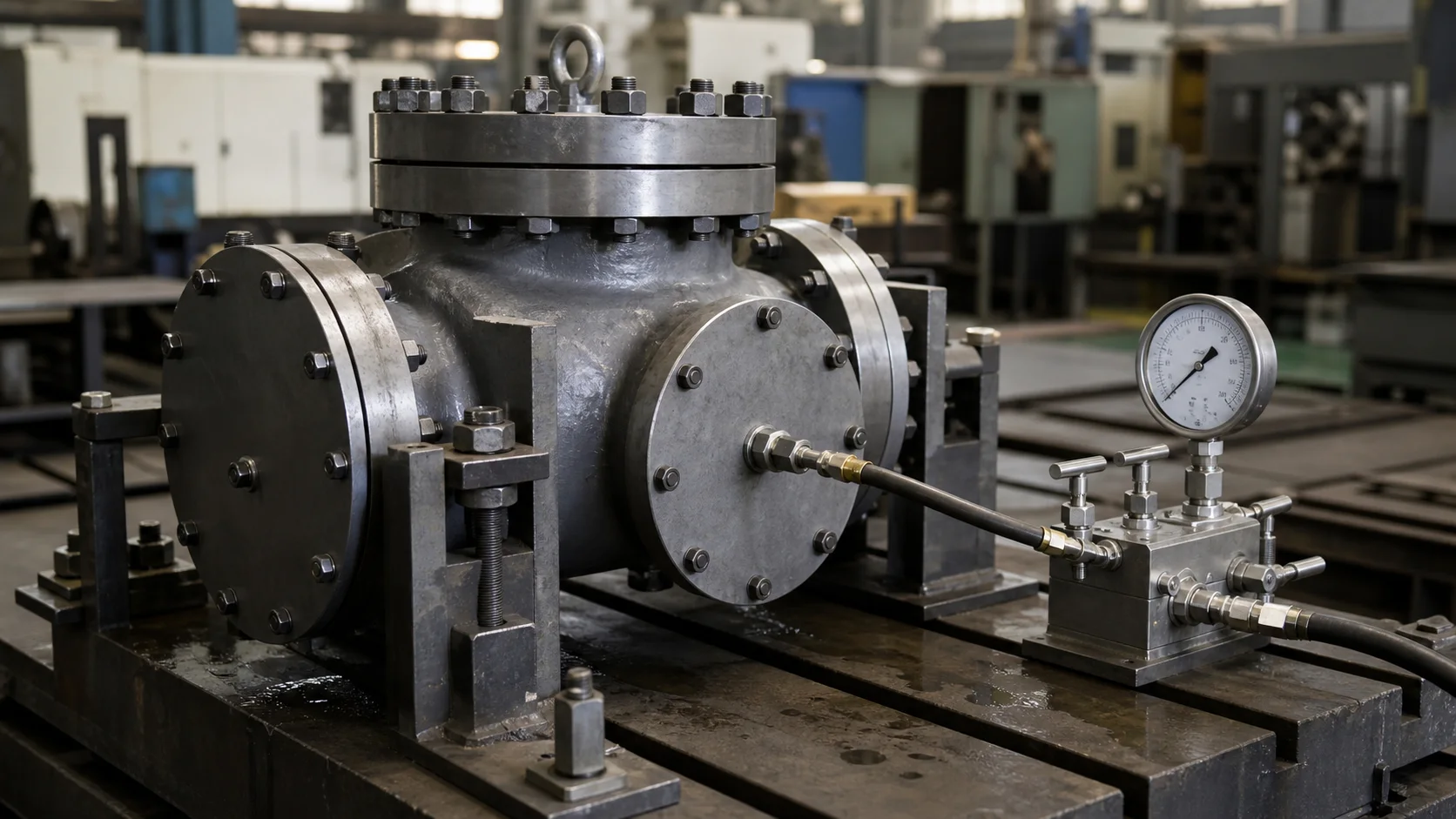
When purchasing valve bodies, pump casings, or complete valve sets, "having undergone pressure testing" is not a sufficiently clear acceptance criterion. Shell testing, top seal testing, high-pressure seal testing, and low-pressure seal testing verify different parts of the valve, and the test medium, pressure, holding time, and allowable leakage cannot be mixed up.
In conclusion: the shell pressure test primarily verifies the integrity of the valve's pressure-bearing boundary, while the sealing test primarily verifies the sealing capability of the valve seat and closing element. Hydraulic pressure testing is typically used for shell and high-pressure seal checks, while low-pressure gas testing is more likely to expose minor seal leaks, but gas storage is greater and more dangerous, requiring the use of qualified equipment and protective measures. Formal acceptance testing should specify the applicable standard, valve type, nominal size, pressure rating, test medium, pressure holding time, and leakage level.
Valve pressure testWhat are the main types?
| Test Project | Main verification object | Common media orientation | Key observation locations |
|---|---|---|---|
| shell test | Structural integrity of valve body, valve cover and pressure-bearing connections | Mainly clean water and other liquids | Valve body surface, valve cover connection, end connection and pressure-bearing boundary |
| Top sealing test | Valves with top sealing structure | According to product standards and agreements | Sealing part on valve stem |
| High pressure sealing test | Valve seat, closing element and sealing pair | liquid-based | Valve seat sides, closing element and internal passage |
| Low-pressure sealing test | Valve seat sealing capability under low pressure conditions | air or inert gas | Bubbles, pressure drop, or specified leakage rate |
Different valves do not necessarily require exactly the same test combinations. For example, the closing structure, pressurization direction, and permissible leakage rules of gate valves, globe valves, ball valves, butterfly valves, and check valves may differ; the test items will also differ between valves with and without a top seal. The procurement documents should be based on the specific product standards and the acceptance specifications confirmed by both parties.
What exactly does a shell hydrostatic test check?
Shell testing focuses on pressure boundaries, not whether the valve seat can close completely. During testing, the shut-off element is typically positioned according to the standard specifications, fully pressurizing the valve body cavity and related pressure-bearing parts. Then, the valve body, valve cover, connections, and other pressure-bearing boundaries are observed for any visible leaks, structural abnormalities, or abnormal pressure retention.
For cast valve bodies, hydrostatic testing can detect some through-hole defects and pressure boundary problems, but it cannot replace all casting quality control.
- Material confirmed:Spectroscopic or material certification is used to confirm the grade; pressure testing cannot determine whether CF8M truly meets material standards.
- Surface defect inspection:Penetrant or magnetic particle testing is suitable for detecting surface opening defects; all problems should not be addressed until the hydrostatic testing stage.
- Internal defect assessment:Whether X-ray or ultrasonic testing is required should be determined based on product standards, wall thickness, risks, and contracts.
- Dimensions and processing:The sealing surfaces, flange faces, hole positions, and wall thickness still need to be inspected separately according to the drawings;
- Performance of complete valve sets:The fact that the casting blank passes the pressure test does not mean that the valve seat seal, opening and closing torque and overall machine performance will automatically pass the test after assembly.
Do you have drawings for valve bodies, pump casings, or pressure castings?It is possibleSend drawings and pressure requirements via WeChatThis specifies the material, medium, temperature, pressure, quantity, and testing standards; you can also view...Precision casting capability for pump and valve components。
What is the difference between a hydrostatic test and an airtightness test?
| Comparison items | Liquid pressure test | Low-pressure gas sealing test |
|---|---|---|
| Common uses | Shell strength and pressure-bearing boundary, high-pressure seal | Valve seat low-pressure seal and minor leak observation |
| Compressibility | Liquids have low compressibility and can store relatively little energy. | Gases are compressible and can store a large amount of energy. |
| Leakage manifestations | Observe for seepage, dripping, or pressure changes. | This can be observed through bubbles, flow rate, or pressure drop. |
| Safety priorities | Expel air, reliably seal, and slowly increase pressure. | Isolation and protection, restriction of personnel access, and use of qualified equipment. |
| Can they be substituted for each other? | It cannot be substituted by oneself; it should be carried out in accordance with product standards, media, and procurement agreements. | |
The risks of using gas for high-pressure shell testing are generally higher than those of liquid testing because the energy and impact of compressed gas being released rapidly are greater. Without standard guidelines, risk assessments, and dedicated protective devices, a hydrostatic test should not be arbitrarily converted to a high-pressure gas test simply to "easier detect leaks."
Is a higher leakage level always better?
Leakage ratings must be understood within the context of specific standards and test conditions. Simply stating "zero leakage," "Class A leakage," or "highest level" without specifying the referenced standard, valve type, size, test medium, differential pressure, and holding time can easily lead to misunderstandings between the parties involved.
The permissible leakage of the valve seat is usually related to the following factors:
- Soft seal or metal seal;
- Valve nominal size and pressure rating;
- Is the test medium a liquid or a gas?
- Pressure direction and valve seat structure;
- Methods for measuring pressure holding time and leakage;
- Do the product standards have stricter or different provisions than the general testing standards?
Soft-seal ball valves and metal-hard-seal high-temperature valves have different application environments and should not be treated with the same phrase "zero leakage is required." A more reasonable approach is to specify the target leakage level in the drawings or procurement specifications and confirm manufacturing and testing costs before providing a quote.
How to choose between GB/T 13927, ISO 5208, API 598 and ASME B16.34?
| standard | Main uses | Usage method during procurement |
|---|---|---|
| GB/T 13927-2022 | Industrial valve metal valve pressure test | Commonly used test standards for industrial valves in China need to be combined with product standards. |
| ISO 5208:2015 | Valve pressure test in metal industry | When the internationally accepted testing framework differs from specific product standards, the product standard shall prevail. |
| API 598 | Valve inspection and testing | This is common in oil, chemical, and international valve projects; the version of the contract used should be clearly specified. |
| ASME B16.34 | Design and manufacturing requirements for flange, threaded and welded end valves | Requirements covering pressure and temperature ratings, materials, non-destructive testing, examinations, and markings. |
According to the National Standards Public Service Platform, GB/T 13927-2022 came into effect on July 1, 2023, completely replacing GB/T 13927-2008 and adopting ISO 5208:2015. The ISO website indicates that ISO 5208:2015 will undergo review and confirmation in 2025 and remains the current version. The ASME website currently lists ASME B16.34-2025 as the current version.
Standards cannot simply list the number without specifying the version.Different versions may vary the scope, terminology, test items, or acceptance criteria. If the customer's product standard differs from the general pressure testing standard, the specific requirements of the product standard should generally be followed, and the conflict resolution principles should be specified in the contract.
What are the common causes of water leakage during valve body pressure testing?
- The casting has a through-hole defect at the bearing boundary:For example, leakage channels related to shrinkage cavities, inclusions, cracks, or weld repair quality;
- Poor sealing of valve cover or end tooling:Leaks in tooling caused by gaskets, blind flanges, clamping force, or the condition of the sealing surface can easily be misdiagnosed as leaks in the valve body.
- Damage to wall thickness in threaded holes or machined surfaces:Insufficient drilling depth, machining allowance, or wall thickness in the drawings can cause the pressure-bearing boundary to become thinner or penetrate through.
- Valve seat and sealing pair issues:The sealing test failed due to issues with the surface roughness, roundness, coaxiality, foreign matter, scratches, or assembly deviations.
- Incorrect experimental preparation:The air inside the cavity was not completely expelled, the pressure was increased too quickly, the pressure gauge range was inappropriate, or the pressure holding process was unstable.
- Error in understanding experimental boundaries:Phenomena observed in stuffing boxes, testing fixtures, or non-inspected areas are directly identified as casting defects.
Upon discovering a leak, the source should first be identified as the tooling, connection, valve seat, or housing before deciding on repair, re-inspection, or scrapping. Directly welding without proper identification may not only mask the cause but also compromise the material's heat treatment condition and subsequent traceability.
Can a casting blank be directly used to make a set of valves for pressure testing?
The casting blank, the machined valve body, and the assembled valve are at different manufacturing stages. The pressure boundary inspection can be arranged according to the process or contract at the blank stage, but the standard pressure test of the complete valve assembly usually depends on the complete assembly of the valve cover, valve seat, closing element, valve stem, packing, and seals.
When procuring valve body castings, it is recommended to clearly define the delivery boundaries:
- Only deliver the casting blanks, and provide material and appearance inspection;
- For machined valve bodies, additional checks are conducted on critical dimensions, sealing surfaces, and pressure-bearing boundaries.
- The finished valves were delivered for assembly, and the shell and sealing tests were completed according to the product standards.
- The foundry, in conjunction with the customer's specialized tooling, conducted the valve body hydrostatic verification.
- Do you need stress curves, photos, videos, testimonial records, or third-party reports?
What should be included at a minimum in a valve pressure test record?
- Product name, drawing number, specifications, pressure rating, and unique identification information;
- Implementation standards and versions, test items, and acceptance levels;
- Test medium, medium temperature and environmental conditions;
- Test pressure, holding time, and direction of pressure application;
- Pressure gauge or sensor serial number, range, and calibration status;
- Observation results, measured leakage amount and conclusions;
- Operator, inspector, date, and customer testimonial information;
- The retest record after repair should not only retain the final qualified result.
Bulk orders should also specify whether testing is done on a per-unit basis or by sampling, the record retention period, the report language, and the furnace number or batch traceability. For pressure-bearing, low-temperature, corrosive, or export projects, these documents are often just as important as the product itself.
Inquire about valve body andPump & Valve CastingsWhat information should be provided in advance?
- 2D drawings, 3D models, drawing numbers, and versions;
- Material standards and grades, such as WCB, LCB, CF8, CF8M, or duplex steel casting grades;
- Working medium, design temperature, working pressure, and pressure rating;
- Key wall thickness, machined surfaces, sealing surfaces, and dimensional tolerances;
- Non-destructive testing (NDT) areas, proportions, methods, and acceptance levels;
- Pressure test standards, versions, items, media, and leakage levels;
- Initial quantity, annual usage, delivery time, and whether CNC machining is required;
- Material certification, dimensional reports, test records, and third-party witnessing requirements.
For more material options, please refer toWCB, WCC, LCB, LCC Cast Steel Grade ComparisonThe structure and key processing points of the stainless steel valve body can be viewed here.Guide to Precision Casting of Stainless Steel Valve BodiesThe scope of quality inspection can include...Quality control page。
Frequently Asked Questions
Does passing the water pressure test mean that the valve will not leak?
This does not mean that the shell water pressure is qualified. It mainly indicates that there is no unacceptable leakage or abnormality at the pressure-bearing boundary under the specified test conditions; the valve seat sealing capability still needs to be verified by corresponding high-pressure or low-pressure sealing tests.
Does higher pressure and longer pressure holding time necessarily mean better quality?
No. The test pressure and time should be determined by standards, valve specifications, and design conditions. Arbitrarily increasing the pressure or extending the time may pose safety risks and may cause damage to seals and structures under non-design conditions.
Are air bubbles a defect in the valve body casting?
Not necessarily. Air bubbles could originate from the valve seat, connection, tooling, threads, or housing. The leak path must be located first to determine whether the problem is related to assembly, machining, tooling, or casting.
Is it enough for the client to simply write "test by API"?
Not enough. It is recommended to specify the complete standard number and version, and confirm the valve type, pressure rating, test items, medium, holding time, leakage level, and reporting requirements.
From pressure requirements to valve body manufacturing evaluation
Haijin Stainless Steel can be customized for valve bodies, pump casings, etc.impellerDrawings of fluid equipment parts, and evaluation of stainless steel, carbon steel, and low alloy steel.Investment CastingCNC machining of key sealing surfaces and flange faces, and inspection procedures that match order requirements.
Send valve body drawings and pressure test requirements via WeChat, or enterProcurement ContactThe website facilitates communication via phone and email; for larger amounts of information, direct communication is also possible.Upload drawings to get a quote。
References and Safety Statement
This document is intended for procurement communication and understanding of testing projects and does not replace formal standards, product designs, safe operating procedures, or qualified pressure testing procedures. Pressure testing is hazardous and must be performed by qualified personnel using appropriate equipment under isolated and protective measures. Specific pressures, holding times, leakage rates, and test media shall be based on the current standards, product standards, and written technical agreements adopted in the contract.
National Standard Platform: GB/T 13927-2022 Pressure Testing of Industrial Valves
ISO 5208:2015: Pressure testing of valves for the metal industry
ASME B16.34: Flange, Threaded and Welded End Valves
JB/T 14310-2022: Technical Specification for Valve Pressure Testing Device
Relevant technical information and product examples
Continue to assess whether the materials, workmanship, and actual parts are suitable for your procurement needs.
- Material selectionCommonly used precision casting material grades for water pump impellers→
- Application AnalysisApplication of precision casting in water pump impeller manufacturing→
- Defect controlApplication and Defect Control of Water Pump Head Casting→
- Product ExamplesPrecision casting and CNC machining of valve and pump impellers→
Pump and valve component process evaluation
Do you have drawings of impellers, valve bodies, or pump bodies that need to be evaluated?
Haijin can evaluate precision casting and CNC post-machining solutions by considering corrosion resistance requirements, flow channel structure, wall thickness, sealing surface, and key mating dimensions.
- Material orientation is determined based on medium and temperature.
- Assess the risks of flow channels, wall thickness, and casting defects.
- Confirm the machining of sealing surfaces, hole positions, and mating dimensions.
 WhatsApp: +86 158 9600 2001Scan the QR code or open WhatsApp to chat


