











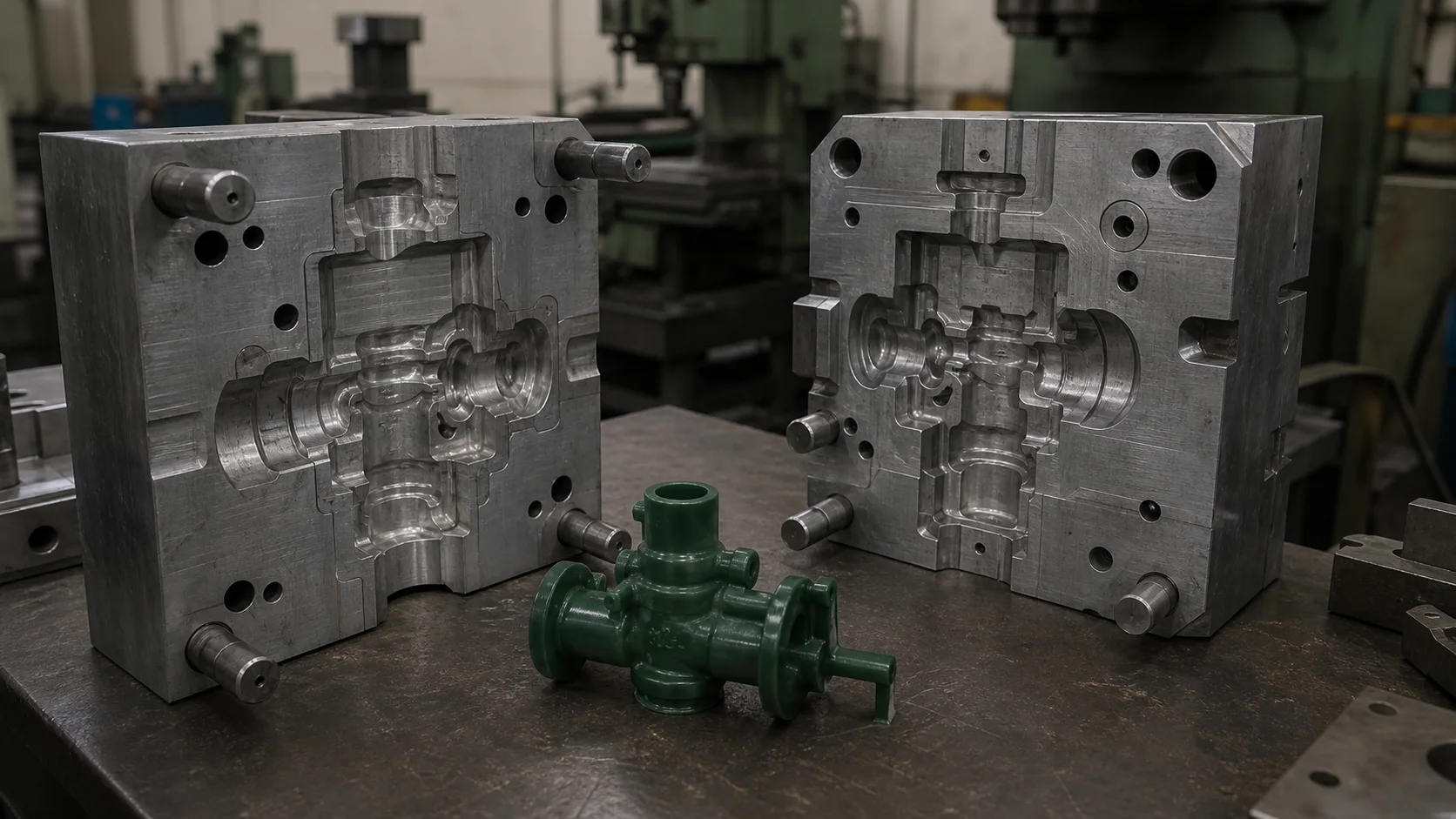
Investment CastingWhen requesting a quote, many buyers first ask "How much does it cost to make a mold?" without providing a 3D model, quantity, or tolerances. Mold costs are not simply calculated based on the weight of the part; they depend on the wax model structure, parting line, core pulling, number of cavities, mold material, and expected lifespan.
In conclusion: Precision casting molds are typically used to press wax patterns, not for directly pouring metal. The more complex the structure, the more cores pulled, the larger the size, the more cavities, and the higher the precision and lifespan requirements, the higher the mold manufacturing and debugging costs usually are. Mold fees, first-piece sample fees, and the unit price of batch castings should be confirmed separately.
What are the components of the cost of precision casting molds?
| Cost items | Main influencing factors |
|---|---|
| Structural design | Parting surface, shrinkage rate, machining allowance, gate, and deformation compensation. |
| Mold material | Aluminum alloys, steel or other options and expected lifespan |
| Processing and manufacturing | CNC machining, wire cutting, EDM, mold making and surface treatment |
| Core pulling and mechanism | sliders, movable inserts, threaded cores, and complex demolding structures |
| Trial molding and modification | Wax model verification, dimensional compensation, deformation correction, and re-sample testing |
| number of holes | Single-hole acupuncture has lower costs, while multiple acupuncture points can improve efficiency but increase initial investment. |
Further Reading:Mold dimensions cannot be simply enlarged from the product dimensions. Please continue reading.Methods for shrinkage rate, mold scaling and first piece size compensation in stainless steel precision casting。
Why is it difficult to accurately quote mold costs when only 2D drawings are available?
2D drawings can illustrate dimensions and tolerances, but complex curved surfaces, internal cavities, undercuts, and parting lines often require 3D models for accurate assessment. Without 3D data, suppliers can only provide hypothetical quotes, which can easily change later due to additional core pulling, adjustments to parting lines, or modifications to allowances.
Do I need to calculate the mold opening and bulk pricing?It is possibleSend 2D images, 3D models, and estimated quantities via WeChatPlease also specify the material, key tolerances, annual usage, and delivery time to facilitate the evaluation of the mold design and unit cost together.
What is the difference between mold fee and sample fee?
Mold fees usually correspond towax moldThe design, manufacturing, and trial molding costs; the prototyping fee may also include wax pattern production, shell making, casting, cutting, heat treatment, CNC machining, testing, and sample logistics. Even if a mold is already available, the first casting and machining verification will still incur separate costs.
Are multi-cavity molds always cheaper?
Multi-cavity molds can improve wax filling efficiency and consistency, but require greater equipment capacity, more complex wax filling balancing, and higher upfront investment. When annual usage is low or products are still undergoing frequent revisions, single-cavity or few-cavity solutions are often more reliable; once the quantity stabilizes, then evaluate expanding the cavity size or replicating the mold.
Why can't the lifespan of a mold be guaranteed for a uniform number of cycles?
- The mold materials, hardness, and surface treatments are different;
- The wax material temperature, pressure, and demolding frequency are different;
- The wear rates of sliders, inserts, and small cores differ;
- Different maintenance, cleaning, and storage conditions;
- Product redesigns may occur before the natural lifespan of the mold ends.
More practical aspects of the contract include clearly defining mold ownership, storage period, maintenance responsibilities, modification costs, and disposal methods after long-term production stoppage.
Which designs significantly increase the difficulty of mold making?
- Inverted and closed cavities that cannot be directly demolded;
- Extremely thin walls, deep holes, and slender cantilever;
- The parting line is located in a high-appearance or high-precision area;
- The dimensions vary greatly and the tolerance requirements are very tight;
- Lack of proper fillets, draft angle, and thickness transition;
- All dimensional requirements that must be guaranteed by CNC machining are directly formed from the blank.
Frequently Asked Questions
Will we be charged mold fees again for bulk orders in the future?
Normally, the same version of the mold can continue to be used, but the costs of mold modification, duplication, major repairs, or exceeding the agreed storage period should be specified in advance in the contract.
Can we make a mold if we have a sample but no drawings?
Reverse engineering can be performed first, but key dimensions, tolerances, materials, and assembly relationships still need to be confirmed by the customer. Simply copying the shape may leave manufacturing and usage risks.
Does a more expensive mold necessarily mean a better casting?
Not necessarily. Molds are only one link in the manufacturing chain; shell making, smelting, casting, heat treatment, machining, and inspection also determine quality.
From mold design to total cost assessment
Haijin Stainless Steel can assess the costs of wax molds, precision casting, CNC machining, and inspection based on drawings. Price factors can be referenced.Stainless Steel Castings Quotation GuideThe structural design can be viewed.Precision Casting Wall Thickness and Fillet GuideWhen all the information is complete,Upload drawings to get a quote。
This document does not provide a fixed price for molds. Actual costs and lead times are subject to the final drawings, mold design, quantity, and written quotation.
Relevant technical information and product examples
Continue to assess whether the materials, workmanship, and actual parts are suitable for your procurement needs.
- Process ComparisonHow to choose between silica sol process and water glass process?→
- Process ComparisonWhat are the differences between precision casting and powder metallurgy?→
- Quality requirementsPrecision casting surface roughness and polishing treatment→
- Product ExamplesCNC machining of industrial and mechanical parts casting→
Manufacturing process evaluation
We need to determine which manufacturing process is suitable for this part.
Please provide the structure, material, quantity, key dimensions, and surface requirements. We will conduct an evaluation based on precision casting, post-processing, CNC machining, and inspection.
- Assess wall thickness, fillet radius, and molding risks.
- Confirm casting allowance and post-machining location
- Select process based on quantity, quality and delivery time.
 WhatsApp: +86 158 9600 2001Scan the QR code or open WhatsApp to chat


