











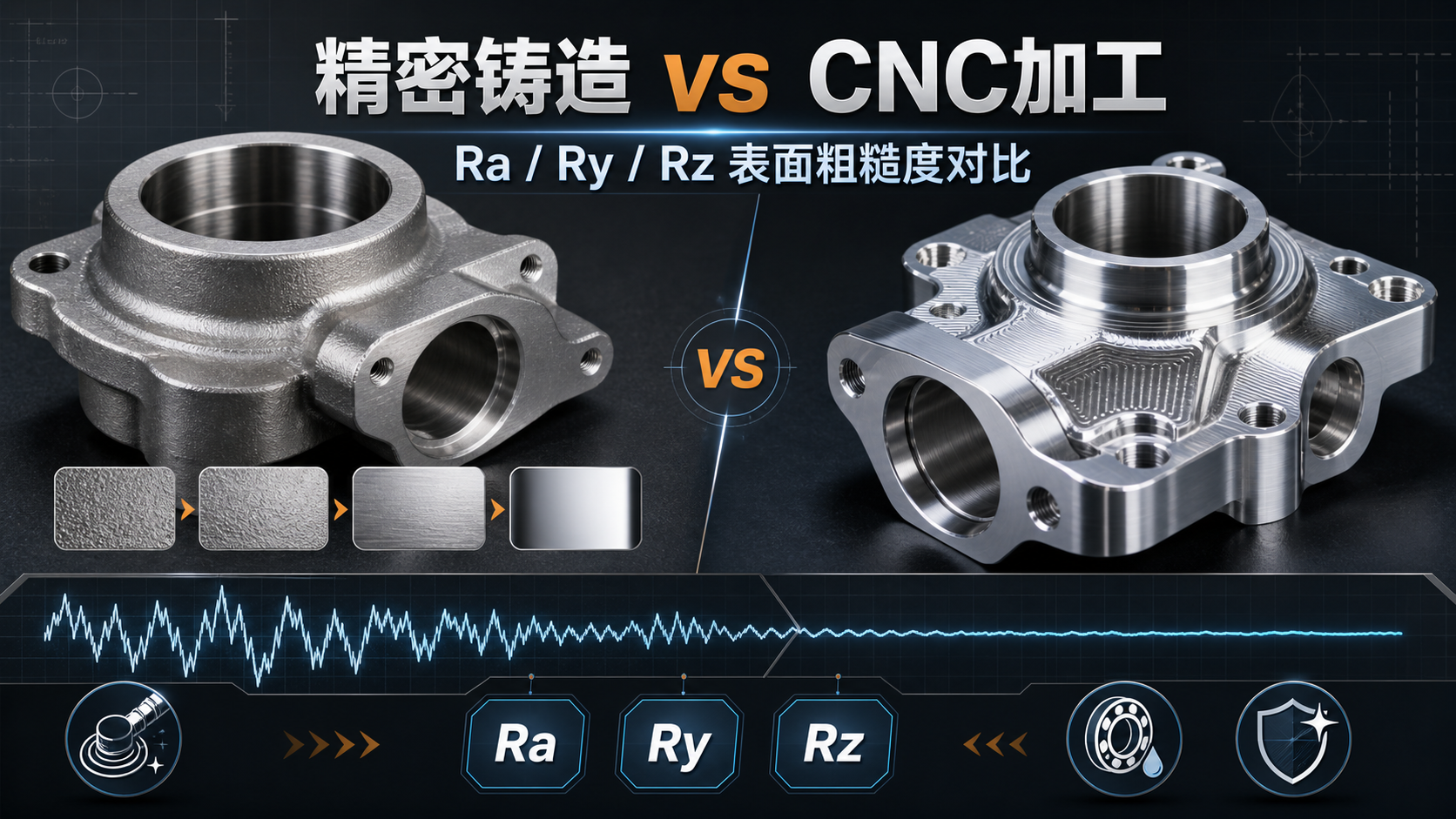
在Investment CastingSurface roughnessIn the procurement drawings, quality reports, or surface treatment requirements for CNC machined parts, you will often see... Ra, Ry, Rz, Polishing Level These are all terms related to surface finish, but they are not the same concept. Choosing the wrong indicator may result in a part that "looks shiny" but fails to meet standards for sealing, fit, wear resistance, or coating adhesion.
This article starts with the practical application of stainless steel precision casting and CNC machining, comparing surface roughness indicators, common polishing states, metal wear risks, and selection ideas for subsequent surface treatments.
1. Surface smoothness and roughness: Judging solely by "shine" is insufficient.
Surface smoothness is a common description of the flatness and fineness of a surface; project acceptance usually uses...Surface roughness parametersQuantification is performed, with units typically in μm. Lower roughness generally indicates lower microscopic peaks and valleys, but a mirror-like appearance does not necessarily mean that critical functional surfaces meet drawing requirements. For example, decorative polishing can be very bright, while sealing surfaces may still have localized scratches or deep valleys that could affect leakage.
II. Differences between surface roughness parameters in precision casting: Ra, Ry, and Rz
| index | Meaning and focus | Suitable scenarios to focus on |
|---|---|---|
| Ra | The arithmetic mean of the absolute values of contour deviations is the most commonly used and convenient method for batch comparison. | CNC machining of standard surfaces, assembly surfaces, general appearance and process control |
| Rz | The parameter reflecting the height of peaks and valleys is more sensitive to more pronounced fluctuations than Ra; the specific algorithm should be confirmed according to the standards referenced in the drawings. | Sealing surfaces, sliding contact surfaces, surfaces before coating, and areas sensitive to localized depressions. |
| Ry | In older versions or specific standards, this was often used to indicate the maximum height of a single segment, highlighting the most severe peak-valley defects. | When controlling deep scratches, burrs, indentations, and extreme surface defects, the standard version to be used must be clearly specified. |
Important Note:Different ISO, JIS, or enterprise standards may have different definitions and sampling methods for Rz and Ry. When requesting quotations, prototyping, and inspecting, the roughness parameters, units, measurement direction, sampling length, and referenced standards should be specified on the drawings, rather than simply writing "polished" or "smooth surface".
III. Comparison of Surface Conditions between Precision Casting and CNC Machining
| project | Investment Casting | CNC machining |
|---|---|---|
| Surface Formation Method | Wax model, shell, pouring, and cleaning together determine the surface finish. | Tool path, cutting parameters, and clamping rigidity determine the surface |
| Typical characteristics | It can form complex curved surfaces, and the original surface has fine cast texture. | Size and local surface finish are more directly controlled, but tool marks may be present. |
| Roughness improvement methods | Optimize molds and shells, sandblasting/shot blasting, grinding, mechanical or electropolishing. | Finishing, precision boring/grinding, feed rate reduction, tool change, grinding or polishing |
| Cost focus | Complex structures can reduce machining work, and key functional surfaces can be further refined. | High-precision functional surfaces offer significant advantages, but machining time increases for complex, fully machined parts. |
| Reasonable combination | The complex main body is formed by precision casting, and then the seals, shaft holes, mating surfaces and sliding surfaces are precision machined and oriented surface treated by CNC. | |
Therefore, precision casting and CNC machining are not simply a matter of "which produces a smoother finish." For pump valves, food machinery parts, marine hardware, or non-standard stainless steel parts, a common and economical approach is...Near-net-shape casting + CNC machining of critical surfaces + necessary polishing/passivation treatment。
IV. How do surface roughness and polishing level correspond?
“"Brushed, matte, glossy, and mirror finish" are descriptions of appearance or process and cannot directly replace the Ra/Rz acceptance value. Mechanical polishing typically removes peaks by using a series of abrasive belts, cloth wheels, and polishing paste; electropolishing can further improve the microscopic smoothness and cleanliness of stainless steel. The actual achievable surface finish is affected by the material, heat treatment, exposure of casting defects, part shape, and polishing accessibility.
| Common surface requirements | Main purpose | Suggested way of expressing |
|---|---|---|
| Cast/Sandblasted Matte | Uniform appearance, removes oxide scale, suitable for non-contact outer surfaces | The blasting medium and sample are agreed upon, and the surface roughness is specified separately for the functional surfaces. |
| Mechanical polishing | Reduce friction and improve cleaning and decorative effects | Specify the direction, appearance sample, and provide Ra/Rz values for key areas. |
| Mirror finish or electropolished finish | Reduces adhesion and cleaning difficulty in food, fluid, or hygienic settings. | Specify the polishing method, passivation requirements, and final surface roughness acceptance. |
V. The Influence of Surface Roughness on Metal Wear, Friction, and Lifespan
- Initial break-in period:Excessively high peaks can be sheared during the initial contact phase, causing metal shavings, scratches, or seizing risks, especially in sliding parts such as bushings, sliders, and valve stems.
- Lubrication retention:Not all parts are better when they are as smooth as possible. Moderate texture can help with oil retention; however, excessive polishing or improper texture orientation can affect the stability of the lubricating film.
- Sealing performance:Localized deep valleys are more likely to form leakage paths than average roughness; therefore, both Ra and peak-valley characteristics should be considered for sealing surfaces.
- Fatigue and Corrosion:Scratches, sharp valleys, and residual contaminants can become stress concentrations or corrosion initiation points. For stainless steel parts, polishing followed by cleaning, pickling/passivation helps improve corrosion resistance.
VI. Surface Treatment Selection: Based on the Usage Environment and Functionality
For stainless steel precision casting and CNC parts, surface treatment requirements can be divided into four categories: for appearance consistency, sandblasting, shot blasting or wire drawing can be selected; for mating and moving surfaces, roughness should be controlled by CNC finishing, grinding or lapping; for food and fluid contact surfaces, fine polishing, electropolishing and passivation can be considered; for marine or corrosive environments, attention should be paid to the material grade, removal of residual iron contamination on the surface and passivation quality.
7. What information should be included in the drawings and procurement acceptance documents?
- Differentiate between the as-cast outer surface and the CNC functional surface, and propose reasonable requirements for each.
- Specify the required Ra, Rz, or Ry values, units, and applicable standards for the critical surfaces.
- Specify the measurement location, measurement direction, sampling length, and whether knife marks, dents, or local scratches are allowed.
- Post-treatment processes such as sandblasting, wire drawing, mechanical polishing, electrolytic polishing, and pickling passivation are incorporated into the process requirements.
- For exterior parts, samples of color, texture, and gloss are provided; for functional parts, acceptance is based on a combination of measurement data and usage tests.
Conclusion
Ra is useful for describing the overall average level, while Rz and Ry better remind engineers to pay attention to local peaks and valleys and extreme defects; polishing level describes the process and appearance, but cannot replace roughness measurement alone. Combining the complex forming capabilities of precision casting, the functional surface accuracy of CNC machining, and appropriate surface treatments can achieve a more reliable balance between cost, wear resistance, corrosion resistance, and product life.
Haijin Stainless Steel can assist in evaluating forming, machining, polishing, and surface treatment solutions for stainless steel precision castings, non-standard CNC parts, and different application scenarios, providing a reference for project prototyping and mass production.
Relevant technical information and product examples
Continue to assess whether the materials, workmanship, and actual parts are suitable for your procurement needs.
- Tolerance dataComparison of CNC Machining Tolerance Standards and Selection→
- Tolerance dataInternational tolerance standard for CNC machining: ISO 2768→
- Surface requirementsComparison of Ra, Ry, Rz with polishing treatment→
- Product ExamplesCNC machining of stainless steel precision casting mechanical parts→
Size and processing assessment
Are there any critical dimensions or CNC machining requirements?
Please provide drawings, materials, quantities, and key tolerances. We will conduct an evaluation based on the condition of the blank, clamping method, processing steps, and inspection requirements.
- Confirm machining datum and clamping method
- Evaluate hole positions, threads, and mating surface tolerances.
- Coordinate casting blanks with CNC machining allowances
 WhatsApp: +86 158 9600 2001Scan the QR code or open WhatsApp to chat


