











When selecting materials for stainless steel railings, decorative panels, kitchen and bathroom hardware, and equipment enclosures, the choice between a brushed or mirror finish often has a more direct impact on the final product than the material itself. Both processes can enhance the appearance of stainless steel, but they address different issues: brushing emphasizes texture and durability for daily use, while mirror finish emphasizes brightness and display effect.
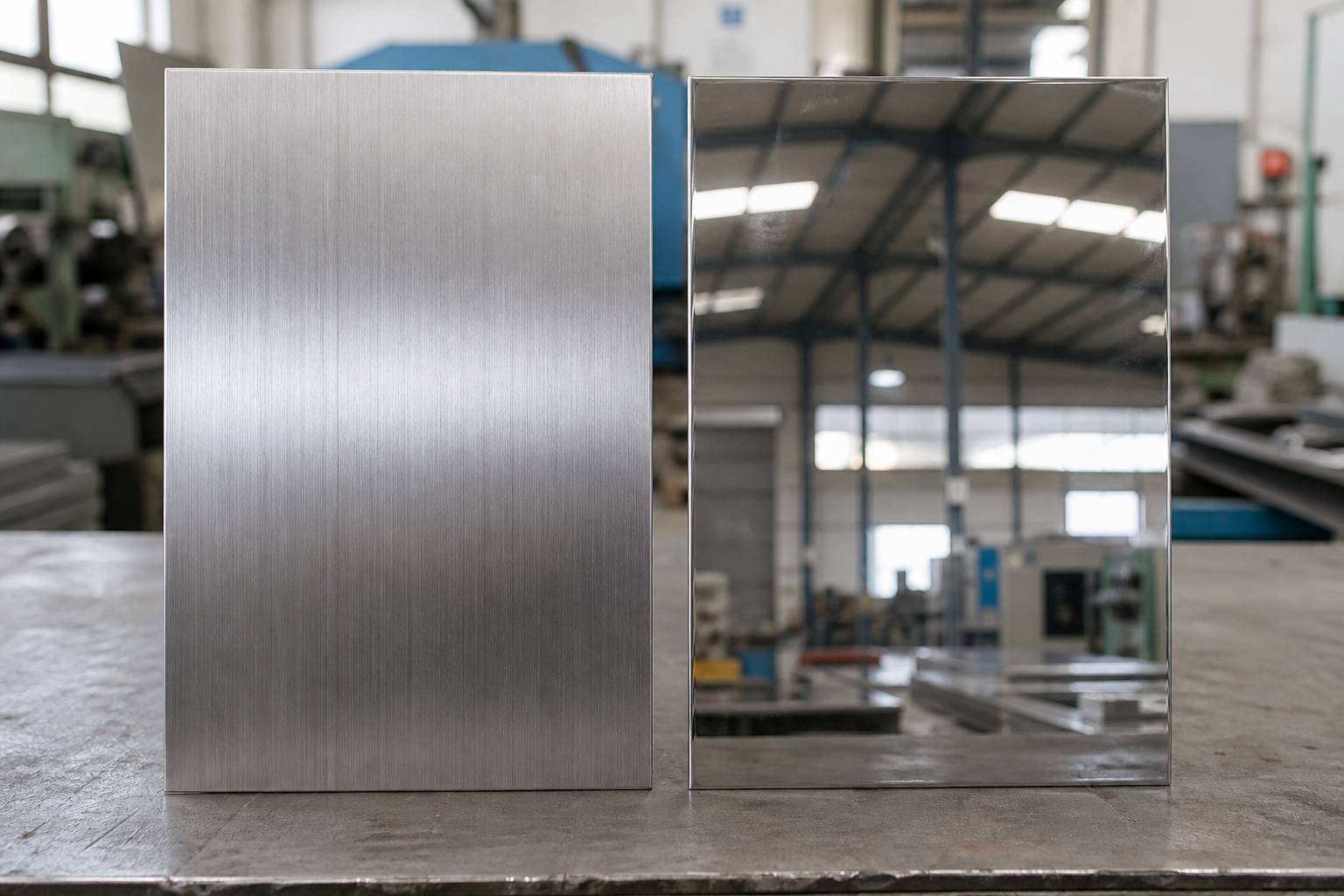
Brushed and polished和Mirror polishingWhich is better?
There is no absolute better; it depends on the usage scenario.For parts that are frequently touched and need to reduce the presence of fingerprints and minor scratches, brushed polishing is usually more suitable; for decorative parts that require high reflectivity, transparency, or visual highlights, mirror polishing can better showcase the effect.
If a project needs to be both practical and visually appealing, the two can be combined. For example, the main body of the handrail can be made of brushed metal, while the signage, trims, or partial decorations can be made of mirror.
What is the difference between the two surface finishes?
| Comparison Projects | Brushed and polished | Mirror polishing |
|---|---|---|
| Appearance features | The texture is even, the luster is soft, and the metallic feel is solid. | The bright surface creates a clear reflection, making it more visually striking. |
| Routine maintenance | Fingerprints and minor scratches are not easily noticeable. | Fingerprints, water stains, and scratches are more easily visible. |
| Processing requirements | The direction and thickness of the texture must be consistent. | Higher requirements for pretreatment and flatness, and usually more processes. |
| Common Applications | Handrails, chassis shells, kitchenware, elevators and building decorations | Display decoration, hotel space, signage, high-end exterior components |
Brushed and polished finish: understated and durable, more suitable for high-frequency use.
A brushed finish features fine, uniform lines on stainless steel, often in a straight-line pattern. Unlike a mirror, it doesn't reflect the surrounding environment and provides a softer look under light. For frequently touched surfaces such as door handles, railings, and equipment panels, a brushed finish helps maintain a clean appearance.
It's important to note that brushed finishes are not "scratch-resistant." If subsequent wiping intersects the existing texture, or if the surface experiences a significant impact, its appearance will still be affected. Therefore, during application and maintenance, it's best to work along the direction of the brush pattern.
Mirror polishing: Higher gloss, suitable for emphasizing visual effects.
Mirror polishing involves progressive grinding and polishing to achieve a high-gloss, near-mirror-like reflective effect on the stainless steel surface. It enhances the sense of light in a space, making it highly attractive in decorative projects, display areas, and delicate hardware.
At the same time, mirrored surfaces are more sensitive to the quality of the underlying surface: small sand marks, improper welding, or unevenness will be more noticeable under reflection. Frequent contact during use also requires more frequent cleaning.
What should be considered when making a selection, considering both cost and delivery time?
Under the same material and size, mirror finishes generally require more meticulous pretreatment and multiple polishing processes, with relatively higher requirements for manual labor and inspection; brushed finishes typically have more stable processing efficiency. However, the actual cost is still related to the product structure, the number of welds, the area, the surface grade, and the order quantity, and cannot be priced directly based solely on the names "brushed" or "mirror."
For welded parts or irregularly shaped castings, it is recommended to confirm the appearance acceptance standards during the prototyping stage: for brushed parts, the direction, thickness, and acceptable joint marks should be clearly defined; for mirror finishes, the brightness level, reflection effect, and whether minor local textures are allowed should be clearly defined.
Selection suggestions for different application scenarios
- Outdoor railings, stair handrails, door and window hardware:Prioritize brushed finishes, as they are less prone to showing signs of wear and tear, making future maintenance easier.
- Food processing equipment enclosures, kitchen and bathroom components:The choice should be based on the frequency of cleaning; if you value the daily appearance, you can choose brushed finish, and if you want to add a touch of embellishment, you can use mirror finish.
- Hotel decorations, display cases, branding components:A mirrored surface can better highlight brightness and sophistication, but you should consider cleaning fingerprints beforehand.
- Non-standard stainless steel parts:First, determine the surface based on the assembly location and touch frequency, then confirm the process accessibility.
Conclusion
The advantages of brushed polishing lie in its aesthetic appeal, practicality, and ease of maintenance; the advantages of mirror polishing lie in its brightness, refinement, and strong visual impact. Instead of asking "which is better," it's better to first determine whether the product is frequently touched, whether it's in a display position, and whether the required maintenance frequency is acceptable. Once these conditions are clarified,Surface treatmentThe selection will be more accurate and more conducive to controlling the quality and cost of the finished product.
Relevant technical information and product examples
Continue to assess whether the materials, workmanship, and actual parts are suitable for your procurement needs.
- Process ComparisonHow to choose between silica sol process and water glass process?→
- Process ComparisonWhat are the differences between precision casting and powder metallurgy?→
- Quality requirementsPrecision casting surface roughness and polishing treatment→
- Product ExamplesCNC machining of industrial and mechanical parts casting→
Manufacturing process evaluation
We need to determine which manufacturing process is suitable for this part.
Please provide the structure, material, quantity, key dimensions, and surface requirements. We will conduct an evaluation based on precision casting, post-processing, CNC machining, and inspection.
- Assess wall thickness, fillet radius, and molding risks.
- Confirm casting allowance and post-machining location
- Select process based on quantity, quality and delivery time.
 WhatsApp: +86 158 9600 2001Scan the QR code or open WhatsApp to chat


