











40Cr is a medium-carbon low-alloy structural steel. The addition of chromium allows the material to achieve a relatively balanced performance between strength, hardenability, and wear resistance. When 40Cr is used in cast steel parts, it does not rely solely on carbon content to increase strength like ordinary carbon steel, nor is it as expensive as high-alloy steel. Therefore, it has high practical value in medium load, impact wear, and complex-shaped parts.
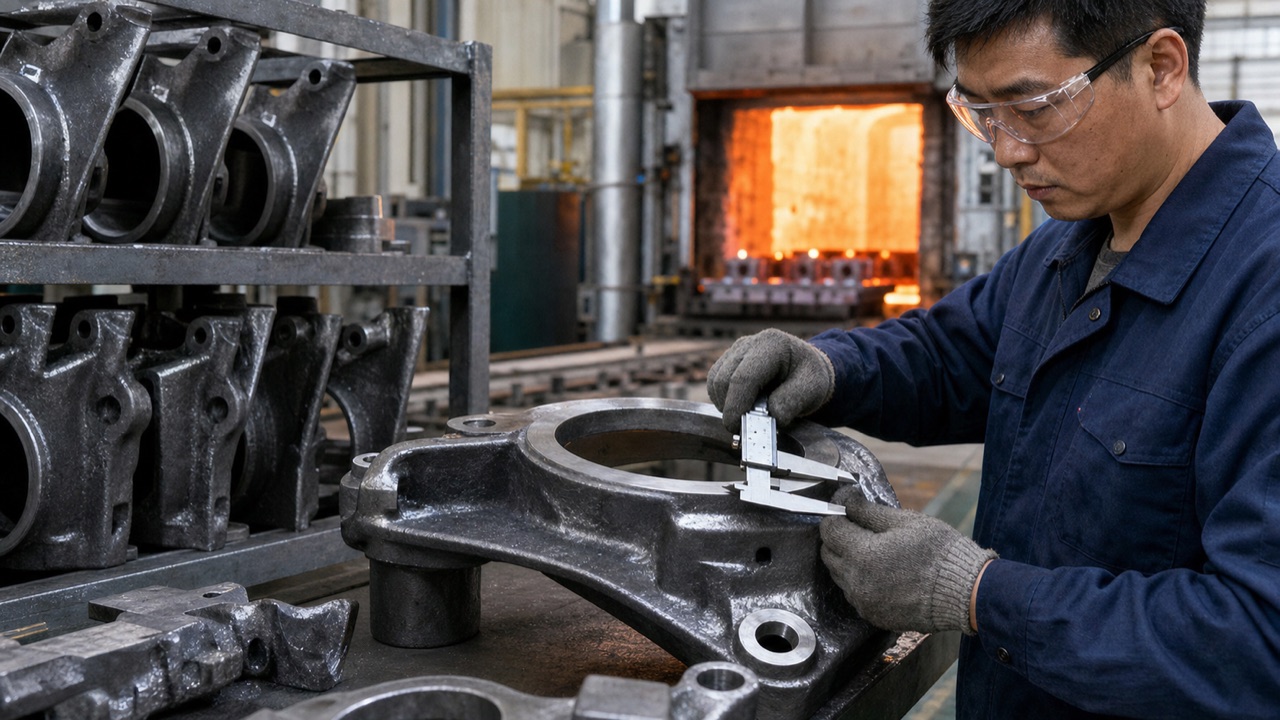
I. Material Characteristics of 40Cr Cast Steel Parts
The typical carbon content of 40Cr is between 0.371 TP3T and 0.441 TP3T, while the chromium content is generally between 0.801 TP3T and 1.101 TP3T. The core purpose of this composition design is to improve hardenability and tempering stability while maintaining a certain level of toughness. For cast steel parts, the wall thickness is often not completely uniform; local hot spots, stiffeners, holes, and corners can lead to differences in microstructure. Compared to ordinary 45 steel, 40Cr is more likely to achieve a more uniform quenched and tempered microstructure over larger cross-sections.
After proper heat treatment, 40Cr cast steel parts can typically achieve high tensile strength, yield strength, and surface wear resistance, while retaining a certain degree of impact toughness. It is suitable for mechanical components subjected to alternating loads, friction and wear, and moderate impacts, such as bushings, gear blanks, connecting rods, supports, hubs, fixtures, and load-bearing components in pumps and valves. However, it should be noted that as-cast 40Cr does not represent its final performance state. Without heat treatment or with insufficient heat treatment, the internal microstructure of the material may be coarse, and the mechanical properties may fluctuate significantly.
II. Key Issues Requiring Control During Casting
The quality of 40Cr cast steel parts depends not only on the grade, but also on the casting process. While chromium improves hardenability, it also makes the material more sensitive to cooling rate, segregation, and heat treatment window. During production, special attention should be paid to shrinkage cavities, inclusions, cracks, decarburization, and microstructure inconsistencies at locations of abrupt changes in wall thickness. For load-bearing components, it is recommended to incorporate 3D structural analysis of gating systems, feeding channels, and machining allowances during the process review stage to avoid leaving defects on the final load-bearing section.
在Investment CastingIn sand casting, 40Cr casting blanks typically require sand removal, shot blasting, flaw detection, and rough machining. For subsequent heat treatment, the more stable the early-stage defect control, the lower the risk of dimensional deformation, quenching cracks, and batch performance dispersion after tempering.
III. Commonly Used Heat Treatment Processes
Common heat treatment routes for 40Cr cast steel parts include normalizing, annealing, quenching and tempering, surface hardening, and stress relief treatment when necessary. The choice of different processes should be determined based on the part's wall thickness, final hardness, machining allowance, and service conditions.
| process | Main purpose | Common control points |
|---|---|---|
| Zheng Huo | Refining grain size and improving the as-cast microstructure prepares the material for subsequent processing or tempering. | The heating temperature is generally higher than the critical point. After heat preservation, air cooling is performed, with a focus on controlling the uniformity of cooling in thick cross-sections. |
| annealing | Reduce hardness, improve machinability, and reduce internal stress | Suitable for blanks with complex structures or large machining volumes; cooling rate should not be too fast. |
| Conditioning | Obtain tempered sorbite to improve overall mechanical properties | Temper promptly after quenching, selecting the tempering temperature according to the target hardness and toughness. |
| Surface hardening | Improve local wear resistance while retaining core toughness | Suitable for areas with localized wear such as tooth surfaces, journals, and guide surfaces; the depth of the hardened layer needs to be controlled. |
| Stress relief treatment | Reduce residual stress after casting, welding, or rough machining | Commonly used for structurally complex parts to prevent deformation during subsequent finishing or use. |
In actual production, 40Cr cast steel parts often follow a process of "normalizing or annealing pretreatment + rough machining + quenching and tempering + finish machining". During quenching and tempering, the quenching medium is usually selected based on the cross-sectional dimensions, such as oil cooling, polymer aqueous solution, or staged cooling. If thin-walled parts are cooled too quickly, deformation and cracks are likely to occur; if thick and large parts are not cooled sufficiently, problems such as low core hardness and incomplete microstructure transformation may occur. Therefore, heat treatment parameters cannot be simply copied from forging or bar stock standards, but should be modified according to the casting structure.
IV. Performance Testing and Quality Assessment
Determining whether 40Cr cast steel parts meet usage requirements cannot be based solely on surface hardness. A more prudent approach is to combine chemical composition, metallographic structure, hardness gradient, mechanical properties, and non-destructive testing. For critical load-bearing components, ultrasonic testing, magnetic particle testing, or penetrant testing can be performed; for batches with higher requirements, tensile testing, impact testing, and metallographic analysis can be arranged. If the parts require subsequent welding repairs, the preheating, post-heating, and tempering treatment of the weld repair area should also be evaluated to avoid localized hardening or crack propagation.
From experience, the ideal state for 40Cr cast steel parts is a balance between hardness, toughness, and dimensional stability. Excessive hardness does not necessarily indicate better quality, especially for parts subjected to impact loads, where excessive hardness may lead to brittleness. Conversely, a uniform tempered martensite structure obtained after proper tempering is often more suitable for long-term service.
V. Typical Application Areas
40Cr cast steel parts are commonly used in machinery manufacturing, mining equipment, construction machinery, pump and valve accessories, transmission components, agricultural machinery, rail systems, and general equipment. They are suitable for manufacturing parts with complex shapes, stable production volumes, and requiring both strength and wear resistance. Examples include support seats, connecting arms, gear blanks, couplings, rollers, wear-resistant bushings, load-bearing parts of valve bodies, and non-standard mechanical parts.
If the parts are exposed to corrosive media, high-temperature oxidation, or strong acid/alkali environments for extended periods, 40Cr is not the preferred material; stainless steel, heat-resistant steel, or duplex steel should be considered. If the operating conditions primarily involve high impact and high fatigue life, further evaluation of material purity, casting defect levels, and impact performance after heat treatment is necessary.
VI. Selection and Procurement Recommendations
When procuring 40Cr cast steel parts, it is recommended not only to provide the material grade, but also to specify the dimensions on the drawings, the weight of each piece, the working load, the heat treatment hardness range, the flaw detection grade, the machining allowance, and the surface treatment requirements. For critical parts, it is best to confirm the amount of heat treatment deformation and the hardness distribution after machining at the prototype stage before proceeding to mass production. This will control costs and reduce rework later.
Overall, the advantages of 40Cr cast steel parts lie in their good comprehensive performance, moderate cost, and strong process adaptability. As long as casting defect control, heat treatment parameters, and testing standards are properly coordinated, they can provide stable and reliable performance in many mechanical load-bearing and wear-resistant applications.
Relevant technical information and product examples
Continue to assess whether the materials, workmanship, and actual parts are suitable for your procurement needs.
- ResourcesComparison of CF8, CF8M, CF3, CF3M with 304 and 316 grades→
- Material Selection GuideHow to choose between 304, 304L, 316, and 316L stainless steel castings→
- Material comparisonWhat are the differences between CF8 and CF8M?→
- Product ExamplesStainless steel mechanical parts casting and CNC machining→
Material and operating condition confirmation
Unsure which stainless steel casting grade to choose?
Please send us drawings and the usage environment. We will take into account corrosion, temperature, strength, processing, and cost requirements to help us determine the most suitable materials and processes.
- Check common terms and casting standards.
- Determining materials by combining medium, temperature and pressure
- Simultaneous confirmation of heat treatment, testing, and certification documents
 WhatsApp: +86 158 9600 2001Scan the QR code or open WhatsApp to chat


