











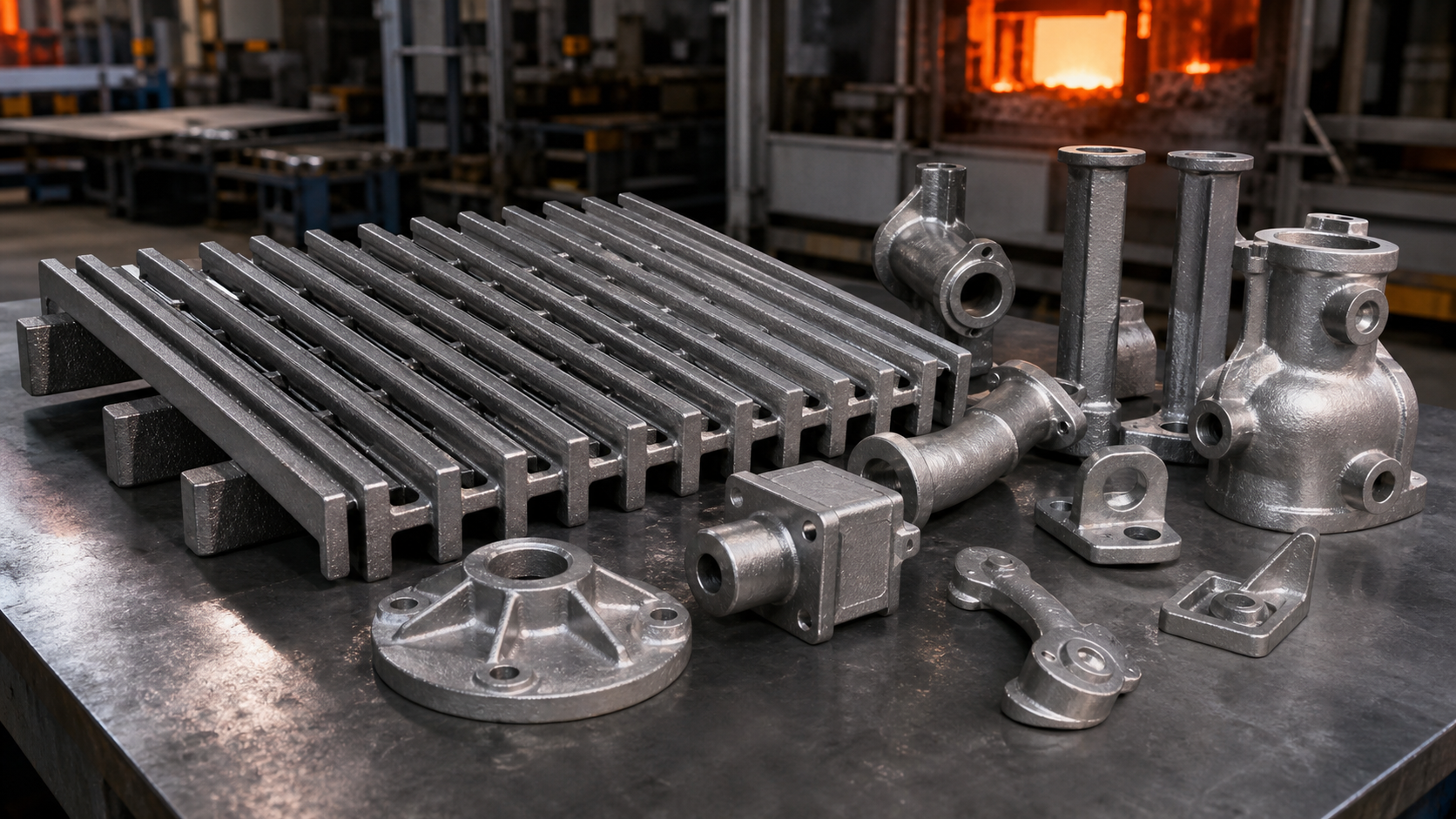
When it comes to producing high-temperature resistant stainless steel castings, many customers initially ask, "Do you have 310S? Can you make 2520?" However, once prototyping and mass production begin, the issue often shifts beyond just the material; it becomes whether the casting can withstand long-term stable use under high temperatures, oxidation, thermal cycling, and assembly loads. When undertaking 310S (2520) heat-resistant steel casting projects, Haijin Foundry considers the material, structure, process, and subsequent machining together, rather than simply casting the shape according to the drawings.
Why is 310S (2520) suitable for high-temperature castings?
310S, also known as 2520 heat-resistant stainless steel, is characterized by its high chromium and nickel content. Chromium helps form a more stable oxide film in high-temperature oxidizing environments, while nickel improves the stability of the austenitic structure and high-temperature toughness. For furnace parts, heat treatment fixtures, combustion equipment accessories, heat-resistant supports, guide rails, grates, clamps, and high-temperature conveying equipment components, 310S is more advantageous than ordinary 304 and 316 in continuous high-temperature environments.
However, 310S is not "suitable for all high-temperature applications." Actual material selection depends on the operating temperature, whether frequent rapid heating and cooling occur, whether it comes into contact with sulfides or chlorides, the thickness differences of the parts, and the stress distribution. For example, even when used inside a furnace, the requirements for oxidation resistance, deformation resistance, and thermal fatigue resistance differ between fixed support components and heat treatment fixtures that are repeatedly moved.
What key aspects should manufacturers control during production?
The challenges of 310S (2520) castings often lie in the details. Firstly, composition control is crucial. For heat-resistant steel, one cannot simply rely on the grade name; the stability of chromium and nickel content, and whether elements such as carbon, silicon, and manganese are within reasonable ranges, all affect high-temperature performance and subsequent processing. Secondly, the casting process is critical. Pouring temperature, riser feeding, wall thickness transition, and cooling rhythm all influence shrinkage cavities, hot cracks, deformation, and internal density.
For non-standard structural parts, we usually first check the thickness differences, sharp corners, long cantilever, and assembly surface locations in the drawings. Areas that can be optimized in advance through fillets, transitions, machining allowances, or parting methods will be confirmed with the customer before mold making or prototyping. This is not to change the product function, but to minimize the risk of later welding repairs, shaping, and rework.
Integrated delivery from casting to machining
Many 310S high-temperature resistant castings are not used directly in their raw state, but require turning, milling, drilling, tapping, surface machining, or finishing of assembly surfaces. Heat-resistant stainless steel itself has high toughness, so the cutting tools, rotation speed, feed rate, and cooling method must be properly coordinated during machining; otherwise, problems such as work hardening, rapid tool wear, and noticeable burrs in holes can easily occur.
Haijin Foundry can provide services based on customer drawings.Investment CastingWe offer sand casting, post-processing, and CNC machining support services. For batch parts, we pay more attention to dimensional consistency and inspection schedule; for single pieces or small batches of non-standard parts, we place greater emphasis on sample confirmation, critical dimension marking, and communication regarding usage conditions.
Quality inspection should not only focus on appearance.
The smooth appearance and absence of obvious defects in high-temperature resistant stainless steel castings only indicate that the first step has been completed. The real factors affecting service life include chemical composition, internal defects, critical dimensions, assembly surface accuracy, and necessary heat treatment conditions. Depending on product requirements, quality can be controlled through methods such as spectral composition analysis, dimensional inspection, penetrant testing, and post-machining re-inspection.
If the casting is intended for use in furnace load-bearing, continuous high-temperature conveying, or frequent thermal cycling applications, customers are advised to provide the operating temperature, environmental medium, stress distribution, expected lifespan, and whether machining or assembly is required when requesting a quote. The more complete the information, the easier it is for the manufacturer to provide reliable process recommendations, rather than simply quoting a seemingly cheap price for a rough blank.
Suitable for custom-made 310S (2520) casting types
- Heat treatment furnace accessories, grates, furnace bars, and heat-resistant support components;
- Heat-resistant mechanical parts in high-temperature conveying, drying, and combustion equipment;
- Tooling components such as furnace clamps, hangers, brackets, guide rails, and positioning blocks;
- Non-standard stainless steel castings requiring oxidation resistance and thermal fatigue resistance;
- Precision castings that require subsequent CNC machining, drilling, tapping, and assembly.
Recommended documents to confirm when purchasing 310S heat-resistant steel castings
To ensure accurate quotations and delivery dates, we recommend providing drawings, material requirements, quantity, unit weight, critical dimensional tolerances, surface treatment, whether machining is required, and operating conditions. If complete drawings are not yet available, you can also provide sample photos, installation location, dimensional sketches, and the operating environment so we can make a preliminary process assessment.
While 310S (2520) high-temperature resistant stainless steel castings may seem like a simple material issue, the actual challenge lies in a manufacturer's comprehensive capabilities in heat-resistant materials, casting defect control, machining fit, and quality inspection. When choosing a manufacturer, it's wiser to ask more questions about process details, testing methods, and similar cases than simply comparing unit prices.
Relevant technical information and product examples
Continue to assess whether the materials, workmanship, and actual parts are suitable for your procurement needs.
- ResourcesComparison of CF8, CF8M, CF3, CF3M with 304 and 316 grades→
- Material Selection GuideHow to choose between 304, 304L, 316, and 316L stainless steel castings→
- Material comparisonWhat are the differences between CF8 and CF8M?→
- Product ExamplesStainless steel mechanical parts casting and CNC machining→
Material and operating condition confirmation
Unsure which stainless steel casting grade to choose?
Please send us drawings and the usage environment. We will take into account corrosion, temperature, strength, processing, and cost requirements to help us determine the most suitable materials and processes.
- Check common terms and casting standards.
- Determining materials by combining medium, temperature and pressure
- Simultaneous confirmation of heat treatment, testing, and certification documents
 WhatsApp: +86 158 9600 2001Scan the QR code or open WhatsApp to chat


