











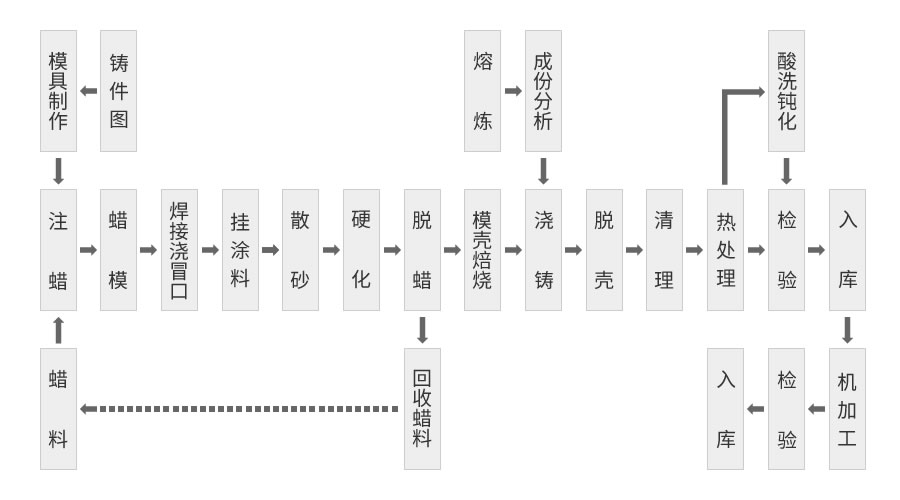
The flowchart illustrates the manufacturing sequence, and the key control points determine the final stability.
Precision casting is not simply a matter of following steps. Molds, wax patterns, shells, melting and pouring, cleaning, heat treatment, and post-processing all influence each other and require control based on the requirements of the part.
First, confirm the material, structure, wall thickness, machining allowance, quantity, and inspection requirements.
Pay attention to wax pattern dimensions, shell strength, smelting composition, pouring conditions, and shrinkage compensation.
Cleaning, heat treatment, surface treatment, and CNC machining are arranged according to material and part requirements.
Inspect materials, appearance, key dimensions, and packaging markings as agreed, and retain necessary records.
Relevant technical information and product examples
Continue to assess whether the materials, workmanship, and actual parts are suitable for your procurement needs.
- Process ComparisonHow to choose between silica sol process and water glass process?→
- Process ComparisonWhat are the differences between precision casting and powder metallurgy?→
- Quality requirementsPrecision casting surface roughness and polishing treatment→
- Product ExamplesCNC machining of industrial and mechanical parts casting→
Manufacturing process evaluation
We need to determine which manufacturing process is suitable for this part.
Please provide the structure, material, quantity, key dimensions, and surface requirements. We will conduct an evaluation based on precision casting, post-processing, CNC machining, and inspection.
- Assess wall thickness, fillet radius, and molding risks.
- Confirm casting allowance and post-machining location
- Select process based on quantity, quality and delivery time.
 WhatsApp: +86 158 9600 2001Scan the QR code or open WhatsApp to chat


