











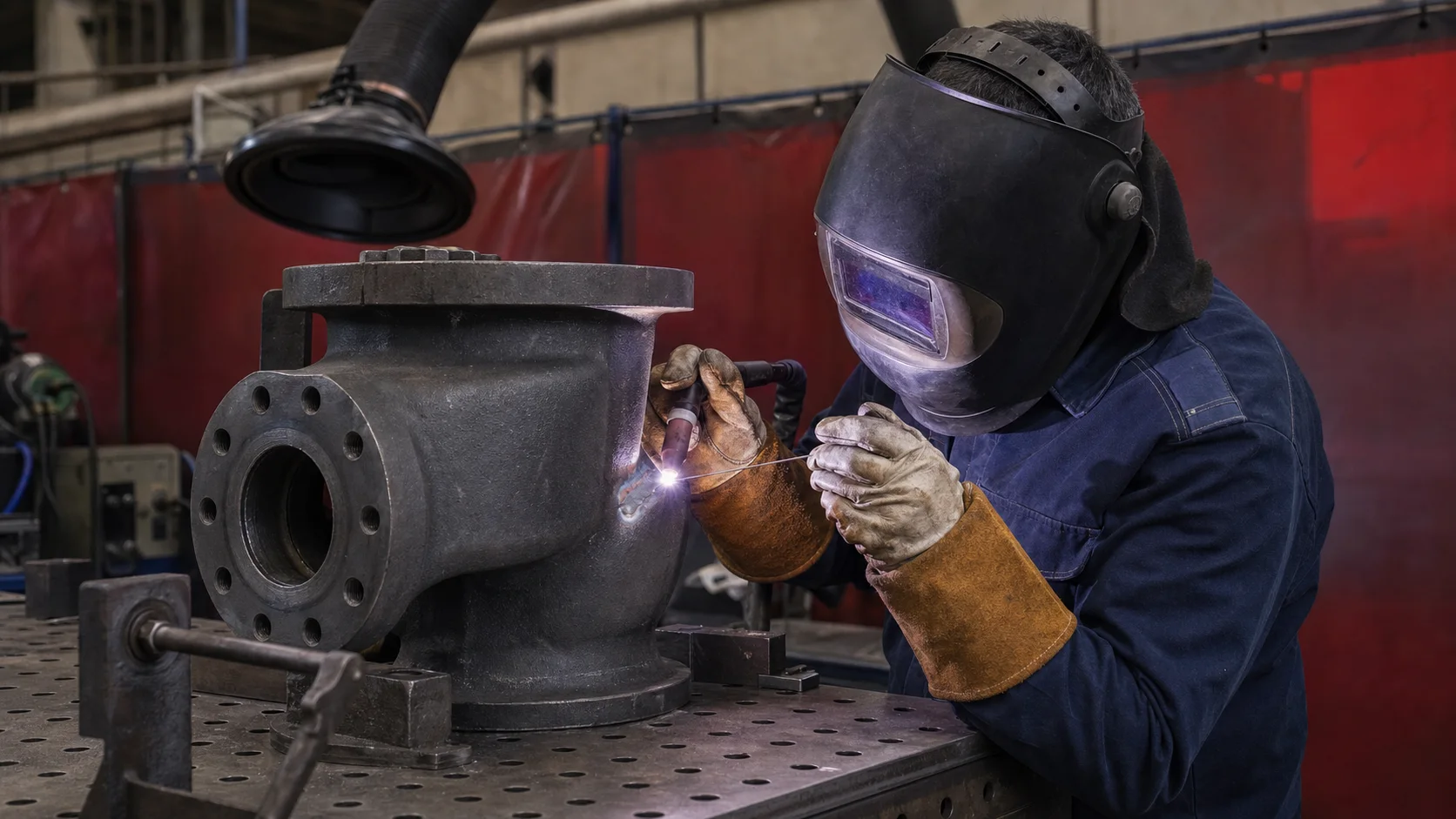
Whether castings can be repaired by welding cannot be answered with a simple "that's how it's done in the industry." Different materials, product standards, defect locations, and operating conditions result in significant differences in the permissible range, approval procedures, and re-inspection requirements for welding repairs.
In conclusion: Cast steel parts can be repaired using qualified welding processes when material and product standards permit. However, pressure-bearing boundaries, near sealing surfaces, low-temperature parts, corrosion-resistant parts, and fatigue stress zones generally require stricter control. Before welding, defects should be removed and the extent confirmed. After welding, heat treatment, grinding, and non-destructive testing should be performed as required. If the customer prohibits welding or requires prior approval, the supplier cannot handle the repair independently.
In what situations might welding repairs be permitted, and in what situations should caution be exercised?
| Condition | Handling principles |
|---|---|
| Small surface defects in non-critical appearance areas | When permitted by standards, cleaning, welding repair, grinding, and re-inspection can be carried out according to procedures. |
| Near the pressure boundary or sealing surface | Product standards, defect depth, weld repair grade, and pressure retesting need to be confirmed. |
| Low temperature, impact or fatigue stress components | Key control points include welding materials, preheating, and heat input.Post-weld heat treatmentand performance |
| Duplex and high-alloy stainless steel | Composition, phase balance, corrosion resistance, and heat-affected zone need to be controlled. |
| Customer or regulations prohibit welding repairs | Do not attempt to repair the product yourself; it should be handled according to the non-conforming product procedure. |
Why can't we immediately cover the defect with weld after it's discovered?
If defects are not completely removed, cracks, inclusions, or shrinkage cavities may remain beneath the weld. The correct procedure typically includes locating, evaluating, mechanically removing, necessary PT or MT verification, beveling, welding according to the welding procedure, followed by grinding and re-inspection.
It is necessary to determine whether the existing castings can be repaired.It is possibleSend material, defect photos, location, and drawings via WeChatFor pressure-bearing or cryogenic components, please also provide the applicable standards, operating temperature, pressure, and customer's welding repair terms.
Why are welding procedure qualification and welder qualifications important?
ASTM A488/A488M-24 specifies the procedures, welder, and operator qualifications for welding and repair welding of steel castings. Material categories include carbon steel, low-alloy steel, austenitic stainless steel, duplex stainless steel, and nickel-based alloys. Different materials cannot simply have the same set of parameters applied simply by changing the welding wire.
The welding process should clearly define the base metal group, welding materials, bevel, preheating, interpass temperature, heat input, welding position, and post-weld treatment. The existence of qualification documents does not automatically mean that all dimensions and critical parts are covered; the scope of application must be verified.
What should be considered when welding repairs of stainless steel and low-temperature cast steel?
- Austenitic stainless steel:Prevent contamination, control heat input, and pay attention to corrosion resistance and thermal cracking tendency;
- Duplex stainless steel:Control phase balance, welding material composition and heat-affected zone, and retest corrosion or microstructure if necessary;
- WCB and other carbon steels:Preheating and stress relief requirements are determined based on carbon equivalent, thickness, and degree of restraint.
- LCB and LCC low-temperature steels:We cannot only guarantee room temperature strength; we must also consider impact toughness and post-weld performance.
What re-inspections are required after welding repair?
- Visually inspect the weld morphology, undercut, craters, and grinding transition;
- Use PT or MT to inspect surface and near-surface defects;
- For major or deep weld repairs, use UT or RT as required;
- The pressure-bearing components shall undergo the specified shell pressure test again;
- If necessary, retest the heat treatment, hardness, mechanical properties, metallographic or corrosion properties;
- Record the location of the defect, the size of the removal, the welding personnel, the process, and the results of the re-inspection.
How should welding repair requirements be clearly stated in a procurement contract?
- Which areas are prohibited from welding repairs, and which require written approval from the customer?
- Definition and reporting thresholds for major weld repairs;
- Applicable welding procedure qualification and personnel qualification standards;
- Methods and levels of non-destructive testing before and after welding;
- Is post-weld heat treatment and pressure retesting required?
- Does the final quality certificate disclose welding repair records?
Frequently Asked Questions
Are welded and repaired castings always defective?
Not necessarily. Weld repairs that meet standards, are technically sound, and pass re-inspection can be considered part of a controlled manufacturing process; concealing weld repairs or exceeding permissible limits is another matter entirely.
Is it okay if I grind it smooth after welding so it's not visible?
No. A smoothed exterior does not prove that the internal fusion, structure, pressure resistance, or corrosion resistance is up to standard; re-inspection and recording are required.
Do all weld repairs need to undergo a complete re-heat treatment?
Not necessarily. It depends on the materials, weld depth, standards, and evaluated processes. It cannot be generalized.
Entering casting quality assessment from the rework boundary
Can be combinedValve pressure test、Quality control和Pressure-bearing cast steel gradesFurther confirm acceptance requirements, or proceed to...Procurement ContactCommunicate new orders and return/repair boundaries.
refer to:ASTM A488/A488M-24 steel casting welding qualificationThis document does not constitute a specific repair approval; actual welding repairs must comply with material standards, product standards, drawings, regulations, and the customer's written requirements.
Relevant technical information and product examples
Continue to assess whether the materials, workmanship, and actual parts are suitable for your procurement needs.
- Process ComparisonHow to choose between silica sol process and water glass process?→
- Process ComparisonWhat are the differences between precision casting and powder metallurgy?→
- Quality requirementsPrecision casting surface roughness and polishing treatment→
- Product ExamplesCNC machining of industrial and mechanical parts casting→
Manufacturing process evaluation
We need to determine which manufacturing process is suitable for this part.
Please provide the structure, material, quantity, key dimensions, and surface requirements. We will conduct an evaluation based on precision casting, post-processing, CNC machining, and inspection.
- Assess wall thickness, fillet radius, and molding risks.
- Confirm casting allowance and post-machining location
- Select process based on quantity, quality and delivery time.
 WhatsApp: +86 158 9600 2001Scan the QR code or open WhatsApp to chat


