











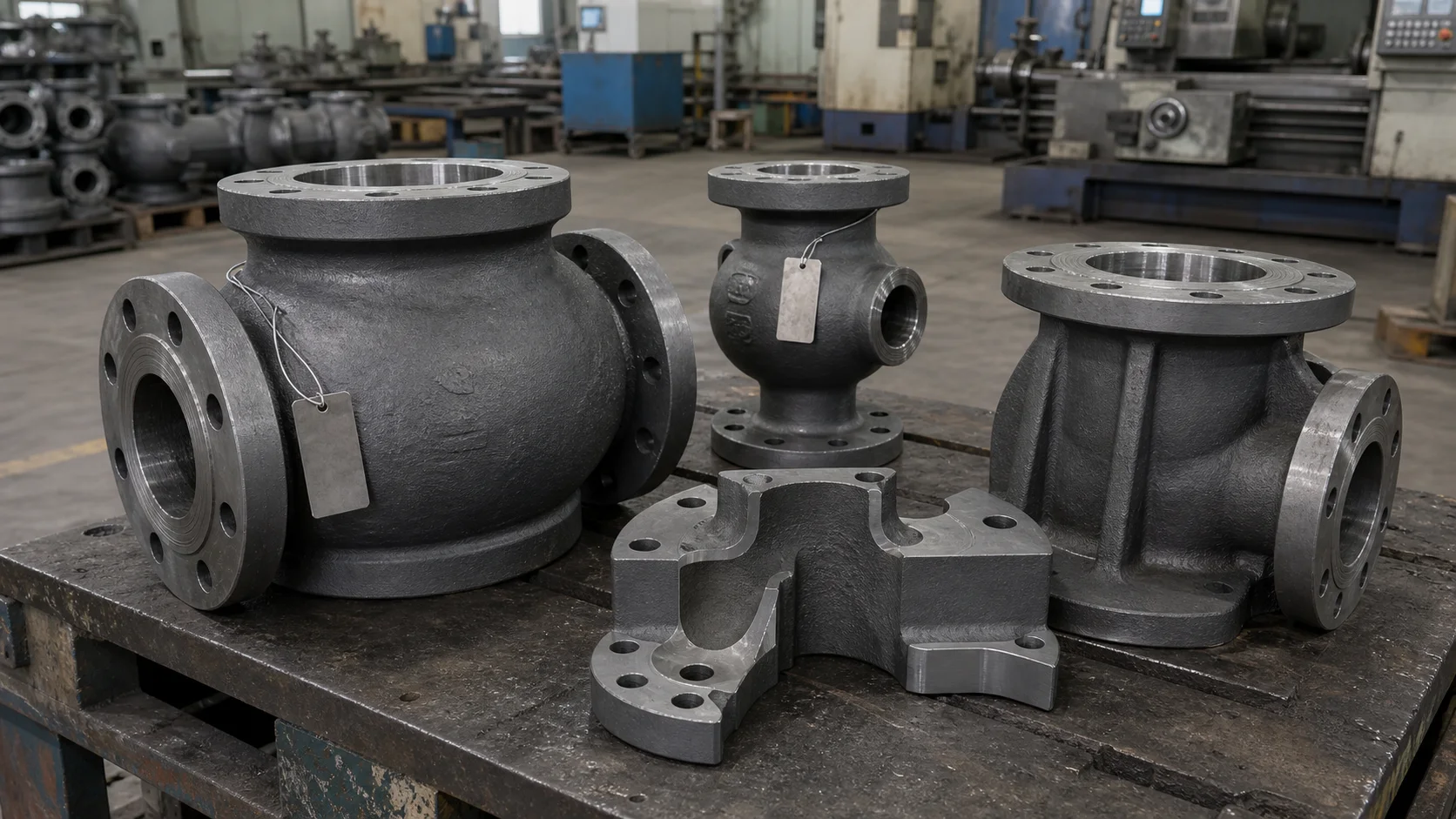
WCB, WCC, LCB, and LCC frequently appear in drawings for valve bodies, pump bodies, flanges, and pressure-bearing connections. They may differ by only one letter, but their material standards, operating temperatures, and inspection focuses are not the same.
In conclusion: WCA, WCB, and WCC are pressure-bearing carbon steel casting grades in the ASTM A216/A216M system, mainly for valves, flanges, pipe fittings, and other weldable high-temperature pressure-bearing parts; LCA, LCB, and LCC belong to the ASTM A352/A352M low-temperature pressure-bearing cast steel system, and it is important to confirm their low-temperature impact performance and test temperature.WCB cannot be simply equated with ordinary "cast iron", and LCB is not simply adding a letter to the beginning of the name WCB.
What are WCB, WCC, LCB, and LCC materials?
| Common brands | Major Standards System | Materials | Common Applications | Procurement Focus |
|---|---|---|---|---|
| WCA | ASTM A216/A216M | Pressure-bearing carbon steel castings | Valve body, flange, pipe fittings | Design strength, heat treatment, welding and pressure requirements |
| WCB | ASTM A216/A216M | Commonly used pressure-bearing carbon steel castings | Valve body, pump casing, pressure-bearing housing | Material standards, mechanical properties, non-destructive testing and shell testing |
| WCC | ASTM A216/A216M | High-strength pressure-bearing carbon steel castings | Pressure-bearing components with higher strength requirements | WCB cannot be used as a substitute; the strength and design conditions must be verified. |
| LCA | ASTM A352/A352M | Low-temperature pressure-bearing cast steel | Cryogenic valves and piping components | Impact test temperature, absorbed energy and heat treatment |
| LCB | ASTM A352/A352M | Commonly used low-temperature pressure-bearing carbon steel castings | Cryogenic valve body, flange, pipe fittings | Low-temperature shock, thickness effect, welding repair and inspection |
| LCC | ASTM A352/A352M | High-strength low-temperature pressure-bearing cast steel | Cryogenic pressure housings and valves | Both strength and low-temperature toughness must be satisfied. |
According to the ASTM website, the current ASTM A216/A216M-26 covers three types of carbon steel castings: WCA, WCB, and WCC. The specific choice depends on the design conditions, mechanical properties, and high-temperature characteristics. ASTM A352/A352M covers ferritic and martensitic cast steels for low-temperature pressure applications. Publicly available information lists the minimum impact test temperature for LCA as typically -32°C, and for LCB and LCC as typically -46°C. However, this is only information on commonly used test temperatures in the standard and does not mean that parts can be used unconditionally at these temperatures.
What is the difference between WCB and WCC?
WCB is a very common grade of pressure-bearing carbon steel castings used in industrial valves, balancing strength, weldability, heat treatment, and manufacturing cost. WCC belongs to the same ASTM A216 system, but has higher requirements for mechanical properties. When choosing, one should not simply ask "which is higher grade," but rather consider the valve's design pressure, temperature, wall thickness, welding, heat treatment, and applicable product standards.
China's new version of GB/T 12229-2025, "Technical Specification for Carbon Steel Castings for General Valves," came into effect on May 1, 2026, replacing GB/T 12229-2005. Publicly available standard information shows that the new version also includes ZG205-415, ZG250-485, ZG275-485, and grades such as WCA, WCB, and WCC, specifying their chemical composition, mechanical properties, heat treatment, dimensions, testing, shell testing, and quality certification requirements.
| ASTM grade | Similar intensity levels in the new version of GB/T 12229 | Common European Reference Systems | Common Reference Systems in Japan |
|---|---|---|---|
| WCA | ZG205-415 | Non-alloy pressure-bearing cast steel series in EN 10213 | JIS G 5151 SCPH series |
| WCB | ZG250-485 | It is often compared with GP240GH (1.0619) and other models in engineering applications. | I often look for corresponding design directions in the SCPH series. |
| WCC | ZG275-485 | It is often compared with GP280GH (1.0625) and other models in engineering applications. | Check each item according to SCPH grade, strength, and operating condition. |
The table above only represents common engineering comparison directions, not unconditional equality.For example, WCB and ZG250-485 have similar room temperature mechanical properties in the new national standard, but their chemical composition boundaries, standard references, heat treatment, sampling, non-destructive testing, weld repair, shell testing, and documentation requirements may still differ. Formal orders should directly specify the applicable standard and grade, rather than simply stating "WCB corresponding national standard material".
Do you have drawings for WCB, WCC, or cryogenic valve bodies?You can go through firstSend drawings via WeChatThis specifies the medium, temperature, pressure, quantity, and testing standards; you can also view...Pump and valve parts casting capabilities。
Why can't LCB and LCC be directly replaced by WCB and WCC?
Under low-temperature conditions, even if a material meets the room temperature tensile strength requirements, insufficient toughness may increase the risk of brittle fracture. ASTM A352/A352M specifies requirements for materials, heat treatment, and impact testing of cryogenic pressure castings. The value of LCB and LCC lies not only in their designations but also in the entire cryogenic acceptance logic.
- Impact test temperature:It must be consistent with standards, design minimum metal temperature, and customer requirements;
- Impact energy absorption:It should be determined according to product standards, thickness and agreement, and cannot simply be written as "undergo low temperature impact";
- Heat treatment condition:It will directly affect strength, toughness, and microstructure;
- Section thickness:Obtaining uniform properties in large, thick-walled castings is more difficult than in small test blocks;
- Welding repair and post-weld treatment:The welding repair procedure and re-inspection requirements for low-temperature castings should be confirmed in advance.
For current cryogenic valve castings in China, JB/T 7248-2024 can be used as a reference. This standard will be implemented from October 1, 2024, and will replace JB/T 7248-2008. European projects typically select G17Mn5, G20Mn5, or other alloy cast steels based on cryogenic performance within the EN 10213 system; Japanese cryogenic high-pressure cast steel uses the SCPL system of JIS G 5152. When comparing different systems, chemical composition, heat treatment, mechanical properties, and impact tests should be performed; literal substitution is insufficient.
How can I find global standards for pressure-bearing cast steel?
| Region or organization | Common Standards | Scope of attention |
|---|---|---|
| ASTM | A216/A216M, A352/A352M | High-temperature carbon steel pressure castings, low-temperature ferritic and martensitic pressure castings |
| Chinese GB/JB | GB/T 12229-2025, JB/T 7248-2024 | General-purpose carbon steel castings for valves, low-temperature steel castings for valves |
| ISO | ISO 4991:2024, ISO 4990:2023 | General delivery requirements for pressure-bearing steel castings and steel castings |
| Europe EN | EN 10213 | Technical delivery terms for steel castings for pressure equipment |
| Japan JIS | JIS G 5151, JIS G 5152 | High-temperature and high-pressure cast steel, low-temperature and high-pressure cast steel |
ISO 4991:2024 is the current international standard for pressure-bearing steel castings, covering pressure-bearing components subject to and not subject to pressure vessel specifications, and including both non-alloy and alloy cast steel materials. ISO 4990:2023 specifies general delivery requirements for steel, nickel, and cobalt alloy castings. When product material standards differ from general delivery requirements, the specific material or product standard should generally prevail.
For more information on stainless steel, alloy steel, and international grades, please refer to [link/reference].Complete list of metal material grade comparison tablesThe specifications for casting tolerances have been updated to reflect the new standard; please refer to the documentation.GB/T 42124.3-2025 Standard for Tolerances of Castings。
What are the differences between WCB and A105?
WCB is a cast steel grade, commonly used for valve bodies, pump casings, and pressure-bearing housings with complex shapes; A105 typically refers to carbon steel forgings for pipeline components. Both can appear in carbon steel valves, but their product forms, manufacturing processes, applicable standards, and acceptance requirements differ. A cast valve body cannot be directly designated as A105 simply because its strength range is similar, nor can a forged part be changed to WCB without re-confirming the design.
What information is required for a price quote on pressure-bearing cast steel parts?
- 2D drawings, 3D models, drawing numbers, and versions;
- Complete material standards and grades, such as ASTM A216/A216M WCB;
- Medium, design temperature, operating temperature, pressure, and minimum metal temperature;
- Casting unit weight, wall thickness, initial quantity, and estimated annual usage;
- Requirements for heat treatment, weld repair, and post-weld heat treatment;
- Location, proportion, and grade of magnetic particle, penetrant, ultrasonic, or X-ray testing;
- Impact test temperature, specimen location, absorbed energy, and reporting requirements;
- Shell testing, dimensional reports, material certificates, furnace number traceability, and third-party inspection;
- The product is delivered as a blank, or it includes CNC machining of the flange face, holes, and sealing surfaces.
For pressure valve bodies, price discrepancies often stem not from the price per kilogram of material, but from factors such as heat treatment, prototyping, non-destructive testing, shell testing, weld limitations, and documentation requirements. Specifying these conditions during the inquiry phase is far more likely to yield an accurate quote than adding them later.
Frequently Asked Questions
Is WCB stainless steel?
No. WCB belongs to ASTM A216/A216M pressure-bearing carbon steel castings. When corrosion-resistant stainless steel castings are required, grades such as CF8, CF8M, and CF3M are usually selected from systems such as ASTM A351/A351M.
Is WCC necessarily better than WCB?
Not necessarily. WCC has higher strength requirements, but material selection must comply with design, temperature, pressure, welding, and product standards. There is no need to increase manufacturing difficulty and cost for a "higher grade".
Can LCB be used at -46℃?
ASTM A352 publicly available information typically lists the LCB (Limited Base Plate) at an impact test temperature of -46°C, but this test temperature is not the same as the automatic permissible operating temperature of the equipment. Ultimately, the specific temperature must be determined by the design specifications in conjunction with wall thickness, stress, impact energy, and the minimum design metal temperature.
Can the WCB directly replace the ZG250-485?
Direct substitution is not recommended. While both materials exhibit similar mechanical properties in the new version of GB/T 12229, their chemical composition, applicable standards, and acceptance criteria differ. Substitution must be based on material comparison and written confirmation from the customer.
From grade confirmation to casting and machining evaluation
Haijin Stainless Steel can evaluate carbon steel, low alloy steel, and stainless steel based on drawings of valve bodies, pump bodies, flanges, and other non-standard castings.Investment CastingCNC machining and inspection plans for critical dimensions. For pressure-bearing or cryogenic projects, material standards, heat treatment, and acceptance documents should be confirmed before mold opening.
Sending drawings and material requirements for cast steel parts via WeChat, or enterProcurement ContactThe website facilitates communication via phone and email; however, users with complete information can also directly access the website.Request a Quote。
References and Alternative Disclaimers
This document is compiled based on the publicly available standards and scope of application from ASTM, the National Standards Public Service Platform, ISO, and the Japanese Standards Association, and is intended solely for material selection and procurement communication. Cross-standard grades mentioned are for engineering reference only and do not constitute material equivalence, design approval, or acceptance criteria. Chemical composition, mechanical properties, impact temperature, heat treatment, sampling, non-destructive testing, and documentation requirements may differ between standards; any substitutions should be based on official standards, drawings, contracts, and written confirmation from the client.
ASTM A216/A216M-26: Pressure-bearing carbon steel castings
ASTM A352/A352M: Low-Temperature Pressure-Bearing Cast Steel
National Standards Platform: GB/T 12229 Standard Substitution Relationship
National Standard Platform: JB/T 7248-2024
ISO 4991:2024: Pressure steel castings
JIS G 5152: Cast steel for low temperature and high pressure applications
Relevant technical information and product examples
Continue to assess whether the materials, workmanship, and actual parts are suitable for your procurement needs.
- ResourcesComparison of CF8, CF8M, CF3, CF3M with 304 and 316 grades→
- Material Selection GuideHow to choose between 304, 304L, 316, and 316L stainless steel castings→
- Material comparisonWhat are the differences between CF8 and CF8M?→
- Product ExamplesStainless steel mechanical parts casting and CNC machining→
Material and operating condition confirmation
Unsure which stainless steel casting grade to choose?
Please send us drawings and the usage environment. We will take into account corrosion, temperature, strength, processing, and cost requirements to help us determine the most suitable materials and processes.
- Check common terms and casting standards.
- Determining materials by combining medium, temperature and pressure
- Simultaneous confirmation of heat treatment, testing, and certification documents
 WhatsApp: +86 158 9600 2001Scan the QR code or open WhatsApp to chat


