











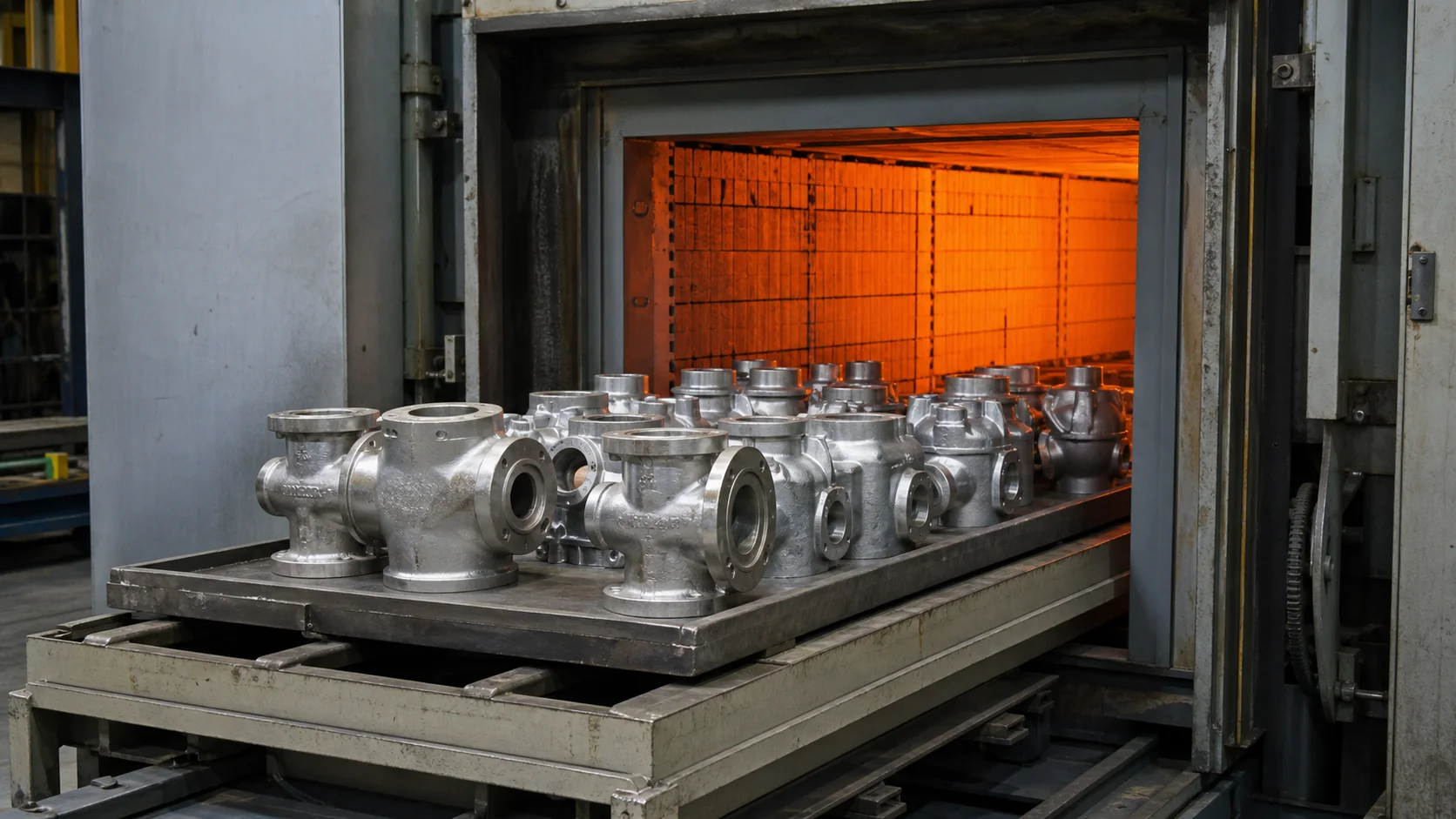
Why is solution treatment necessary after stainless steel castings have been poured and cleaned? In procurement, solution treatment, annealing, stress relief, and quenching are often mixed together, or even only "heat treatment" is required without the grade, temperature record, or performance target.
In conclusion, the core of solution treatment for austenitic and duplex stainless steel castings lies in using appropriate heating, holding, and rapid cooling to allow unfavorable precipitates to redissolve into the matrix and achieve a suitable microstructure, thereby improving corrosion resistance and performance stability. It is not simply about making the parts harder, nor can a single fixed temperature be applied to all grades of stainless steel, including 304, 316L, 2205, 2507, and 310S.
What are the differences between solution treatment, annealing, and stress relief?
| Processing Name | Main purpose | Confirmation should be made during procurement. |
|---|---|---|
| Solution treatment | Adjusting the stainless steel structure, dissolving undesirable precipitates, and coordinating with rapid cooling | Material standards, minimum temperature, insulation and cooling methods |
| annealing | Generally refers to heat treatment that softens, homogenizes, or eliminates the effects of processing. | The name alone is insufficient; the applicable brand and system must be clearly stated. |
| Stress relief treatment | Reduce residual stress in casting, welding or machining | Temperature must not damage the corrosion-resistant structure or properties. |
| Quenching/Tempering | It is often used in martensitic and low-alloy systems to obtain a combination of strength and toughness. | It should not be confused with solution cooling of austenitic stainless steel. |
304316L castingsWhy are we afraid of sensitization?
When austenitic stainless steel is kept in an unsuitable temperature range, grain boundary carbide precipitation may occur, reducing localized corrosion resistance. Lower carbon grades can reduce risk, but this does not automatically guarantee compliance with all casting, welding, and heat treatment conditions. Solution treatment, cooling rate, section thickness, and weld history all influence the final result.
When purchasing, casting grades and applicable standards should be used, such as CF8, CF8M, CF3M, instead of simply writing 304 or 316L as is customary for sheet metal. Material correspondences can be found in [reference needed].Global Stainless Steel Casting Grade Comparison。
Is it uncertain whether the casting requires solution treatment and corrosion testing?It is possibleSend trademark, drawings and usage medium via WeChatThe assessment should be based on wall thickness, welding repair, processing, and acceptance requirements.
Why is heat treatment more important for 2205 and 2507 duplex steels?
Duplex stainless steels require a proper balance between austenitic and ferritic microstructures and control of harmful intermetallic phases. ASTM A890/A890M specifies that duplex cast steels typically require appropriate heat treatment to improve corrosion resistance and, in some grades, meet mechanical property requirements; higher temperatures, sufficient heat treatment, and rapid cooling may be necessary.
“The presence of ferrite content does not necessarily mean that all tissues are合格 (qualified/acceptable). Important tests may require a comprehensive assessment based on chemical composition, heat treatment records, metallography, corrosion testing, and mechanical properties.
Why do castings deform after heat treatment?
- Differences in wall thickness lead to different heating and cooling rates;
- Inadequate support methods can cause thin-walled or long cantilever sections to deform under high temperatures.
- Residual stress from casting is redistributed during heat treatment;
- The furnace is overcrowded or the water cooling flow is uneven.
- The machining datum and allowances before and after heat treatment were not coordinated.
Therefore, critical mating surfaces usually require final machining after heat treatment, and reasonable allowances should be reserved in the design drawings. (See reference)Precision Casting Machining Allowance Guide。
What heat treatment data should the purchaser request?
- Material standards, grades, and heat treatment conditions;
- The relationship between furnace number, furnace loading batch, and product traceability;
- Temperature profile, insulation records, and cooling methods;
- The effective status of heat treatment equipment and temperature measurement;
- Reports on the mechanical properties, corrosion, or metallographic characteristics after treatment;
- Does the weld repair require re-heat treatment and re-inspection?
Frequently Asked Questions
Does stainless steel always lose its magnetism after solution treatment?
Not necessarily. Cast austenitic stainless steel may retain some ferrite. Cold working, composition, and microstructure can also affect magnetism. Therefore, a magnet cannot be used to replace material and microstructure testing.
Is a higher solution temperature always better?
No. The temperature must meet the grade standard while taking into account the requirements for grain size, oxidation, deformation, and microstructure. Too high or too low a temperature may cause problems.
Is 310S heat-resistant steel also treated according to the 316L system?
This approach cannot be directly applied. The target operating conditions, composition, and heat treatment requirements of heat-resistant steels differ, and should be determined according to the specific casting grade and standards.
Heat treatment evaluation based on grade and operating conditions.
Haijin Stainless Steel can coordinate casting, heat treatment, CNC machining, and inspection based on drawings of austenitic, duplex, and heat-resistant steel castings. (See attached image.)Custom non-standard castings, or enterProcurement Contactcommunicate.
refer to:ASTM A890/A890M duplex stainless steel castingsThis document is for procurement communication purposes only. Actual procedures shall be based on material standards, drawings, and confirmed heat treatment processes.
Relevant technical information and product examples
Continue to assess whether the materials, workmanship, and actual parts are suitable for your procurement needs.
- ResourcesComparison of CF8, CF8M, CF3, CF3M with 304 and 316 grades→
- Material Selection GuideHow to choose between 304, 304L, 316, and 316L stainless steel castings→
- Material comparisonWhat are the differences between CF8 and CF8M?→
- Product ExamplesStainless steel mechanical parts casting and CNC machining→
Material and operating condition confirmation
Unsure which stainless steel casting grade to choose?
Please send us drawings and the usage environment. We will take into account corrosion, temperature, strength, processing, and cost requirements to help us determine the most suitable materials and processes.
- Check common terms and casting standards.
- Determining materials by combining medium, temperature and pressure
- Simultaneous confirmation of heat treatment, testing, and certification documents
 WhatsApp: +86 158 9600 2001Scan the QR code or open WhatsApp to chat


