











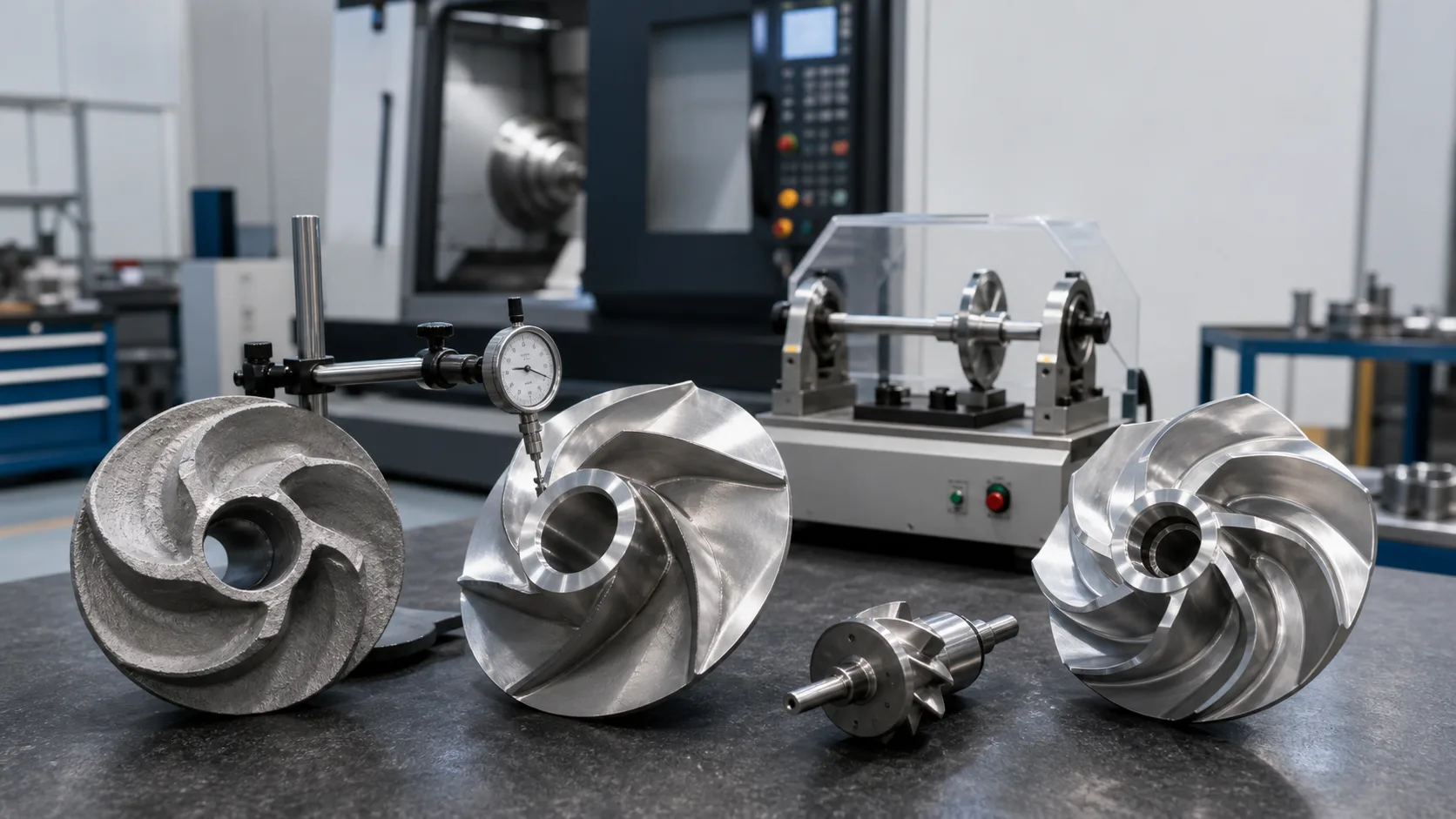
When searching for "precision CNC machining of various impellers" or "pump impeller castings", the procurement personnel are not really solving a single process, but a complete problem: whether complex flow channels can be cast stably, whether shaft holes, end faces and keyways can be machined according to the same datum, and whether the runout and residual imbalance of the finished product during rotation can meet the equipment requirements.
A relatively safe manufacturing route for impellers is usually: silica sol.Investment CastingOnce the shape is nearly formed, retain the critical machining allowance, then complete the CNC precision machining of the shaft hole, end face, stop and keyway, and finally verify the dimensions, runout and dynamic balance according to the drawings or the requirements of the whole machine.Specific materials, allowances, and testing levels cannot be determined by fixed values; they should be determined jointly by the impeller structure, rotational speed, medium, assembly, and acceptance standards.
Which parts of a water pump impeller are suitable for casting, and which parts must be machined?
| Impeller position | Common manufacturing methods | Key points to confirm during procurement |
|---|---|---|
| Blades and flow channels | Precision casting, with cleaning or polishing as necessary. | Blade integrity, flow channel profile, surface condition, and cleaning accessibility |
| Wheel hubs and exterior | Casting and partial turning | Wall thickness transition, shrinkage deformation, rotational mass distribution |
| Shaft hole and stop | CNC boring, turning or grinding | Hole diameter, roundness, coaxiality, fit tolerance and surface roughness |
| end face | CNC turning or milling | End face runout, perpendicularity, and their datum relationship with the shaft hole |
| Keyway, thread, mounting hole | Milling, broaching, drilling or tapping | Position, orientation, depth, and angular relationship with the shaft hole |
Flow channels and curved blades are areas where precision casting excels; shaft holes, sealing fits, and assembly datum typically require post-machining. If the shaft holes are cast directly to the finished size, the dimensions, roundness, and surface quality often fail to meet the requirements for rotary fits. Conversely, if the entire impeller is extensively machined from solid material, it increases material consumption, toolpath, and machining time.
Impeller precision casting first controls the flow channel and wall thickness
The thickness of the blades must allow for the creation of windows.
Thin blades, excessively long flow distances, or sudden changes in cross-section can increase the risk of undercasting, cold shuts, and deformation; excessively thick hubs in certain areas can lead to hot spots and shrinkage cavities. When reviewing drawings, it is important to consider the minimum wall thickness, flow channel length, fillet radius, and hub transition simultaneously, rather than just looking at a single dimension.
The gate and subsequent cleaning must not damage the functional surfaces.
The impeller casting and run-out scheme should avoid critical flow channels and subsequent processing references. After cutting and grinding, it is also necessary to confirm whether it affects the blade profile and mass distribution. For closed impellers or impellers with narrow internal cavities, the accessibility of shell making, dewaxing, cleaning, and inspection must also be assessed.
Materials must be specified in casting grades and standards.
Verbal mentions from purchasing personnel about 304, 316, 316L, or 2205 only provide a general material selection. For formal production, the casting grade, applicable standards, heat treatment condition, and documentation requirements must be confirmed. (See reference below.)Comparison table of commonly used precision casting materials for water pump impellersHowever, the grade comparison cannot replace the drawings and confirmation of operating conditions.
Do you already have drawings for the impeller, pump body, or valve body?You can check it first.Precision casting capability for pump and valve componentsYou can also enterWeChat consultationSend drawings, materials, quantity, speed, and media information.
How to establish machining datum for shaft holes, end faces, and keyways?
CNC machining of impellerThe core principle is not to "machine each dimension precisely" individually, but to establish a unified and repeatable reference relationship. A common approach is to first use relatively stable positions on the blank to complete rough positioning, rough machining out usable references, and then complete subsequent processes around the shaft hole, end face, and stop. The final solution must also take into account clamping space, blade rigidity, and deformation risk.
- First, confirm the assembly reference:Clearly identify which shaft hole, stop, or end face the impeller uses to mate with the shaft and pump body;
- Arrange rough processing:Remove uneven allowances and establish a reference for subsequent repeatable positioning;
- Machining shaft holes and critical end faces:Try to control coaxiality, perpendicularity, and runout within a reasonable clamping relationship;
- Complete keyway and mounting features:To avoid secondary positioning errors from compromising the accuracy of previous steps;
- Verify the rotation-related dimensions:Inspect under a reference condition that closely approximates the actual assembly state.
When machining stainless steel castings, work hardening, intermittent cutting, and uneven blank allowances must also be considered. Inappropriate tools, cutting parameters, and clamping forces can lead to chatter marks, bore drift, or deformation of thin blades. For more information on allowance design, please continue reading.How to leave machining allowance in precision casting。
Coaxiality, end face runout, and dynamic balance are not the same thing.
- Shaft hole dimensions and roundness:Determines whether the shaft and hole can meet the requirements for fit and stable assembly;
- Coaxiality or concentricity:Pay attention to whether multiple rotational elements revolve around a common datum;
- End face runout:It reflects the overall error of the end face relative to the rotating reference;
- Static imbalance:The center of mass is off-axis of rotation, which may be more noticeable on a correction plane;
- Even imbalance and dynamic imbalance:Mass distribution at different axial positions typically requires identification and correction using rotary balancing equipment.
Dimensional compliance does not guarantee dynamic balancing compliance, and dynamic balancing compliance cannot replace the inspection of shaft hole and end face dimensions. ISO 21940-11 specifies the balancing procedure for rigid rotors and the principles for determining unbalance tolerances, including the allowable residual unbalance, the number of correction surfaces, and balancing errors. The specific balancing quality grade and acceptance method for the impeller should be determined by the overall machine design, speed, mass, supports, and customer standards.
Why should dynamic balancing be performed after critical machining processes?
Machining of the shaft hole, end face, keyway, and outer diameter all alter the impeller's mass distribution. If balancing is completed before these critical machining operations, the original results may become meaningless after subsequent material removal. Therefore, balancing checks and corrections should generally be performed after the major machining operations affecting the mass distribution are completed, using agreed-upon clamping and reference standards.
The calibration method can be to remove weight from designated locations, use counterweight in permissible areas, or other methods approved by the design, but critical blades, sealing surfaces, or high-stress areas should not be ground arbitrarily. The calibration location, maximum removal amount, and re-inspection requirements should preferably be specified in the drawings or inspection documents.
When requesting a quote for an impeller, it is recommended to provide these 8 items of information.
- 2D finished product images, 3D models, and drawing versions;
- Material grade, applicable standards, and heat treatment requirements;
- Working medium, temperature, pressure, and corrosive environment;
- Rated speed, maximum speed, and direction of rotation;
- Shaft holes, stops, end faces, keyways, and critical tolerances;
- Dynamic balancing standards, quality grades, calibration methods, and reporting requirements;
- Unit weight, number of samples, batch size or estimated annual usage;
- The delivery includes raw material processing, CNC machining, polishing, inspection, and packaging.
If complete drawings are not available at the moment, please provide photos of the actual object, shaft hole dimensions, outer diameter, number of blades, medium, rotational speed, and a sample. Haijin can first determine whether silica sol precision casting is suitable, and then list the necessary machining and testing information.
Frequently Asked Questions
Is dynamic balancing always necessary after precision casting of the impeller?
It's not necessarily determined by the casting process itself, but rather by the rotational speed, mass, diameter, structure, and overall machine requirements. High-speed or vibration-sensitive rotating parts usually require more specific balance requirements, and low-speed, small parts cannot be exempted from inspection based solely on experience.
Can the impeller be purchased only as a cast blank?
Yes, but it's recommended to have the blank supplier obtain the finished product drawing before mold making to confirm the machining datum, allowance, and permissible trimming area. A disconnect between casting and machining can easily lead to situations where the blank has material but cannot be stably clamped, or where the machining allowance is insufficient.
Are 316 stainless steel impellers always more durable than 304 stainless steel impellers?
Not necessarily. The choice of materials depends on the medium, chloride ions, temperature, corrosion type, strength, and cost. More demanding seawater or chemical environments may require duplex steel or other material systems.
Directly from impeller drawings to process evaluation
The key to impeller orders is ensuring that the casting structure, machining standards, and rotation inspection use the same set of drawings and acceptance logic from the outset. Haijin Stainless Steel can provide evaluations based on drawings.Stainless steel impellerA solution for precision casting, CNC post-machining, and dimensional inspection of pump bodies, pump covers, and valve bodies.
Send impeller drawings and photos via WeChat, or enterProcurement ContactThe website facilitates communication via phone and email; however, it can also be used directly when the information is complete.Request a Quote。
References and Explanations
The principles of rotor balancing in this document are based on ISO 21940-11:2016 and its 2022 revision. The full text of the standard and specific tolerances are subject to copyright and applicable conditions, and this document does not replace design specifications, customer drawings, or formal inspection agreements.
ISO 21940-11:2016: Balancing procedures and tolerances for rigid rotors
ISO 21940-11:2016/Amd 1:2022
Relevant technical information and product examples
Continue to assess whether the materials, workmanship, and actual parts are suitable for your procurement needs.
- Material selectionCommonly used precision casting material grades for water pump impellers→
- Application AnalysisApplication of precision casting in water pump impeller manufacturing→
- Defect controlApplication and Defect Control of Water Pump Head Casting→
- Product ExamplesPrecision casting and CNC machining of valve and pump impellers→
Pump and valve component process evaluation
Do you have drawings of impellers, valve bodies, or pump bodies that need to be evaluated?
Haijin can evaluate precision casting and CNC post-machining solutions by considering corrosion resistance requirements, flow channel structure, wall thickness, sealing surface, and key mating dimensions.
- Material orientation is determined based on medium and temperature.
- Assess the risks of flow channels, wall thickness, and casting defects.
- Confirm the machining of sealing surfaces, hole positions, and mating dimensions.
 WhatsApp: +86 158 9600 2001Scan the QR code or open WhatsApp to chat


