










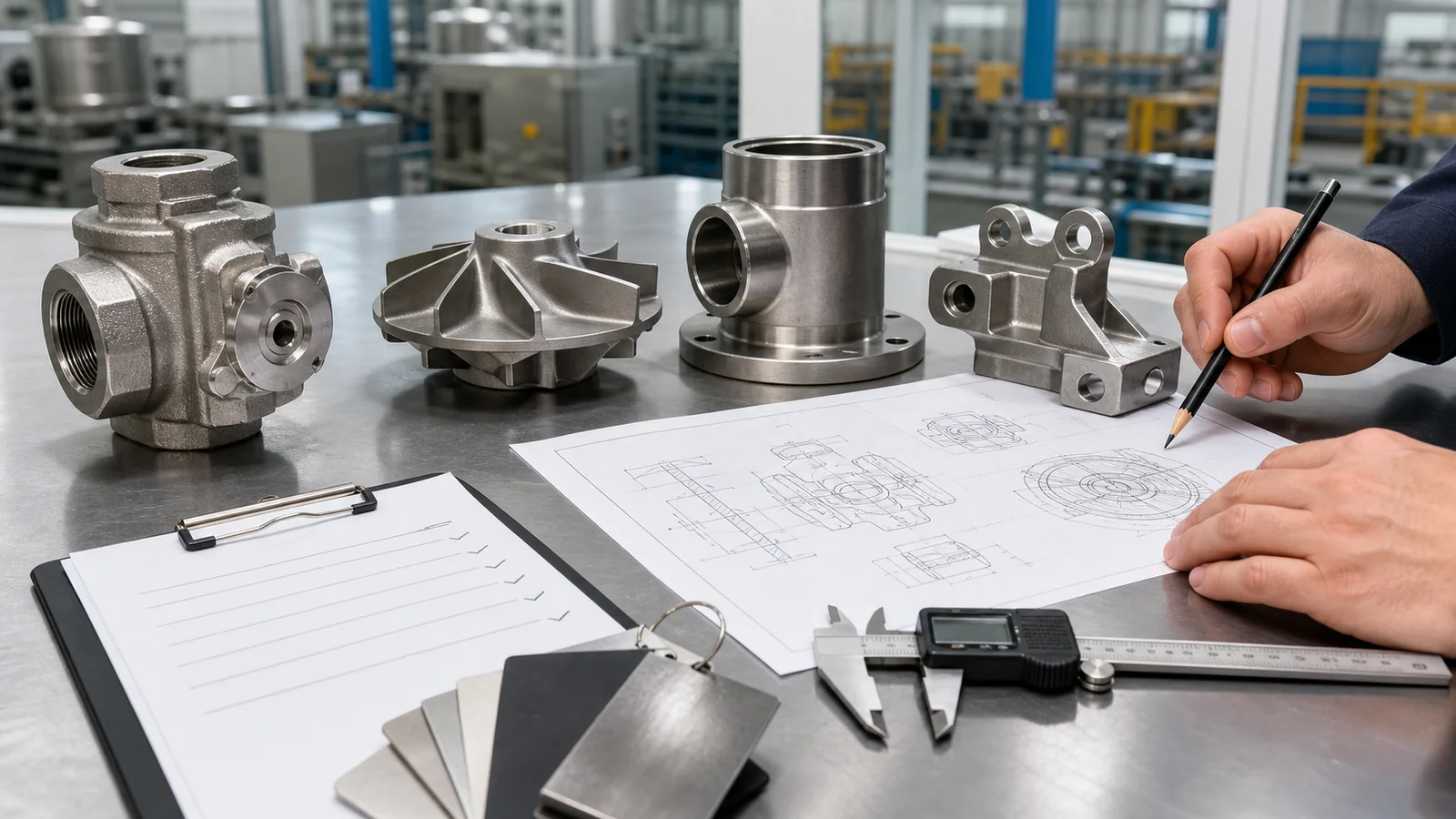
“"How much does this stainless steel casting cost per kilogram?"Investment CastingThis is a common question during price inquiries, but for custom-made parts based on drawings, simply looking at the material and weight usually doesn't provide a reliable quote. For example, a simple bracket with thin walls, weighing around 1 kg, might be a simple 304 stainless steel casting.impellerFor multi-hole valve bodies and seals requiring precision machining, the costs of molds, yield, processing, and testing can be completely different.
The key to accurate pricing is not to provide a uniform price per kilogram, but to confirm the manufacturing and inspection processes required from the drawings to the finished product.The following analysis breaks down the impact from a procurement perspective.Stainless steel precision castingThe main factors affecting the price are identified, and a list of readily available quotations is provided.
InfluenceStainless steel casting price quote9 factors
1. Completeness of drawings and part structure
Two-dimensional drawings are used to confirm dimensions, tolerances, and technical requirements, while three-dimensional models facilitate the analysis of curved surfaces, internal cavities, wall thickness, and mold structures. Even with only a product photograph, initial communication is possible, but it's difficult for factories to accurately determine weight, parting line, shrinkage compensation, and machining locations.
Deep cavities, blind holes, intersecting runners, thin walls, abrupt changes in thickness, long cantilevered sections, and narrow slots all increase the difficulty of molding, shell making, casting, or cleaning. The more complex the structure, the more necessary a manufacturability assessment is to be conducted before providing a quote.
2. Material grade and applicable standards
When a purchaser verbally mentions "304" or "316," it only indicates a general material direction. When used for casting, the corresponding casting grade, applicable standards, chemical composition, heat treatment, and material documentation requirements should also be confirmed. The raw material, smelting, and heat treatment costs for 316L, 2205, 2507, 310S, and other alloy materials differ and cannot be uniformly estimated using the standard 304.
For applications involving pressure, food processing, chemicals, seawater, or high temperatures, even more stringent material and testing requirements may apply. Specifying the intended use environment as early as possible can help avoid having to reselect materials after submitting a quote.
3. Unit weight and process yield
The quotation uses not only the net weight of the finished product, but also factors such as the gating system, risers, cutting losses, and remelting. Two parts with the same finished weight will have different overall metal consumption and production efficiency if one has a compact structure and high tree-running efficiency, while the other has a more dispersed shape and requires a larger gating system and risers.
4. Wall thickness, fillet radius, and casting risks
Thick areas are prone to hot spots and shrinkage cavities, while excessively thin areas may result in insufficient filling. Sharp corners and abrupt changes can also increase stress and cracking risks. To ensure stable production, factories may need to adjust fillet radius, wall thickness transitions, pouring direction, and feeding methods, all of which will affect mold and trial production costs.
5. Mold design and purchase quantity
New products typically require molds or wax molds. The requirements for mold life, number of cavities, tree arrangement, and production cycle time differ for samples, small batches of a few dozen pieces, and projects with continuous annual usage. The more specific the quantity, the easier it is for the factory to determine whether to adopt a more flexible pilot production approach or design more stable tooling for batch efficiency.
When requesting a quote, it is recommended to provide both the initial quantity and the estimated annual usage, rather than simply stating "please provide a price first." This helps to separate the one-time mold cost from the unit production cost.
6. CNC machining content
The price range for casting blanks differs greatly from that for finished products that can be directly assembled. Machining of holes, threads, sealing surfaces, shaft holes, flange ends, mating dimensions, and complex curved surfaces involves equipment, cutting tools, fixtures, processes, and inspection time.
If the drawings have strict requirements for coaxiality, position, flatness, or surface roughness, these critical dimensions should be specified in the quotation stage. Simply stating "CNC machining required" without specifying the machining scope can easily lead to inconsistent pricing from different suppliers.
7. Surface treatment and heat treatment
Sandblasting, pickling and passivation, polishing, wire drawing, and specific heat treatments all have different requirements for equipment, labor, and appearance acceptance. For parts with mirror finish or high appearance requirements, the original surface of the casting, the accessibility of grinding, and batch consistency must also be evaluated.
8. Testing Items and Document Requirements
Routine appearance and dimensional inspections differ in cost from spectral analysis, material reports, penetrant testing, radiographic testing, pressure testing, mechanical property testing, metallographic examination, or third-party inspection. The scope of testing, sampling ratio, and acceptance criteria should be confirmed before a quote is provided.
Non-destructive testing (NDT) is not about doing as many tests as possible; rather, it should be selected based on the part's intended use, the associated risks, and the drawing standards. Applying high-grade pressure-bearing component testing methods to ordinary non-pressure-bearing hardware parts often only increases costs.
9. Delivery schedule, packaging, and delivery rhythm
Mold making, prototyping, material preparation, mass production, CNC machining, and testing all require scheduling. Urgent orders, small-batch multi-part deliveries, and individual or special protective packaging for single items will all alter manufacturing and logistics arrangements.
Want a more accurate quote for your castings?Please provide drawings, material specifications, quantity, machined surfaces, testing requirements, and expected delivery date. Haijin can provide an assessment.Custom stainless steel castings based on provided drawings、Silica sol precision casting及CNC post-processingplan.
Why are there such large differences in prices between different foundries?
First, it's important to confirm whether the range of each quote is consistent. Some quotes only include the casting blank, while others include machining, surface treatment, and inspection; some list mold fees separately, while others allocate them to the unit price; some quote based on standard material specifications, while others include specialized testing.
When comparing quotes, it is recommended to check the following items one by one:
- Are the material grade and the implementation standard the same?
- Is the quote for a raw material, a semi-finished product, or a ready-to-assemble product?
- Are mold fees and sample fees listed separately?
- Are the CNC machining range and key tolerances consistent?
- Does it include heat treatment, surface treatment, and testing?
- Are the packaging, taxes, shipping costs, and delivery dates consistent?
- Are the handling of non-conforming products and batch quality requirements clearly defined?
The lowest unit price does not necessarily represent the lowest procurement cost. If the initial drawing review is insufficient, subsequent issues such as mold modifications, rework, poor assembly, or delivery delays may result in higher overall costs.
Stainless steelCasting InquiryList of materials
- Product drawings:PDF, DWG, DXF or other 2D drawings;
- 3D model:STEP, STP, IGS, and other formats;
- Material requirements:Brand name, implementation standards, and whether substitutions are permitted;
- Purchase quantity:Number of samples, initial quantity, and estimated annual usage;
- Key dimensions:Tolerances, form and position, surface roughness, and assembly relationships;
- Processing requirements:Which surfaces, holes, threads, and mating areas require CNC machining?
- Surface and heat treatment:Sandblasted, passivated, polished, or heat-treated condition;
- Testing requirements:Material, size, non-destructive, pressure, or performance testing;
- Operating conditions:Medium, temperature, pressure, load, and corrosive environment;
- Delivery requirements:Expected delivery date, packaging, and batching plan.
Even if the information is not yet complete, we can still communicate first. For products that have physical objects but no drawings, you can first provide photos from multiple angles, key dimensions, uses and quantities, and then determine whether measurement, reverse modeling or sample confirmation is needed.
How can we reduce casting costs without sacrificing quality?
- Complete the structural and processing benchmark review before mold making to reduce later mold modifications;
- Clearly specify the truly critical dimensions, tolerances, and inspection items to avoid overly stringent requirements for all locations;
- Make reasonable use of the as-cast surface and reduce unnecessary full-scale CNC machining;
- Provide projected annual usage to optimize molds and production scheduling by batch size;
- Coordinate casting, CNC and inspection within the same quality chain to reduce cross-supplier errors;
- Mass production will begin after the first piece is confirmed; assembly and inspection issues will be resolved first.
Frequently Asked Questions
Can you provide a quote without 3D drawings?
A preliminary assessment can be made based on two-dimensional drawings or sample photos, but for complex curved surfaces, internal cavities, and irregular structures, it is best to supplement with a 3D model in order to confirm the weight, mold, and processing plan.
Why can't we just quote prices per kilogram?
Price per kilogram cannot reflect factors such as mold design, structural complexity, yield rate, CNC machining time, inspection, and surface treatment. Standardized, simple parts can be estimated based on weight, but...Custom castings based on provided drawingsThe price still needs to be calculated based on the complete process.
Can you produce small batches of stainless steel castings?
It can be evaluated. For small-batch projects, the economic viability needs to be determined by considering factors such as mold investment, unit weight, structural complexity, and subsequent repurchase plans. Some products can be sampled and verified first.
How long does it take to get a formal quote?
It depends on the completeness of the data and the complexity of the product. The clearer the drawings, materials, quantities, processing and testing requirements, the faster the technical review will be; complex pressure-bearing components or special materials may require further confirmation of standards and operating conditions.
Make the quote truly correspond to the deliverable product
A reliable quotation for stainless steel castings should clearly specify the scope of materials, molds, casting, machining, inspection, and delivery, rather than just a total price. Haijin Stainless Steel provides comprehensive services for stainless steel precision casting, casting blanks, CNC machining, and inspection, catering to the procurement of pumps and valves, machinery and equipment, food processing machinery, building hardware, and non-standard parts.
Submit drawings and procurement requirements online, or enterContactThe page allows users to send materials via WeChat, phone, or email to obtain process and quotation evaluations.
References
The principles outlined in this document regarding casting structure, feeding, machining, and defect risks are based on casting defect data from the Investment Casting Institute and the Steel Founders' Society of America's steel casting ordering guidelines. Specific project details are subject to drawings, contract standards, and mutually agreed-upon documents.
Investment Casting Institute: Atlas of Casting Defects
SFSA: Ordering Steel Castings
Relevant technical information and product examples
Continue to assess whether the materials, workmanship, and actual parts are suitable for your procurement needs.
- Process ComparisonHow to choose between silica sol process and water glass process?→
- Process ComparisonWhat are the differences between precision casting and powder metallurgy?→
- Quality requirementsPrecision casting surface roughness and polishing treatment→
- Product ExamplesCNC machining of industrial and mechanical parts casting→
Manufacturing process evaluation
We need to determine which manufacturing process is suitable for this part.
Please provide the structure, material, quantity, key dimensions, and surface requirements. We will conduct an evaluation based on precision casting, post-processing, CNC machining, and inspection.
- Assess wall thickness, fillet radius, and molding risks.
- Confirm casting allowance and post-machining location
- Select process based on quantity, quality and delivery time.