










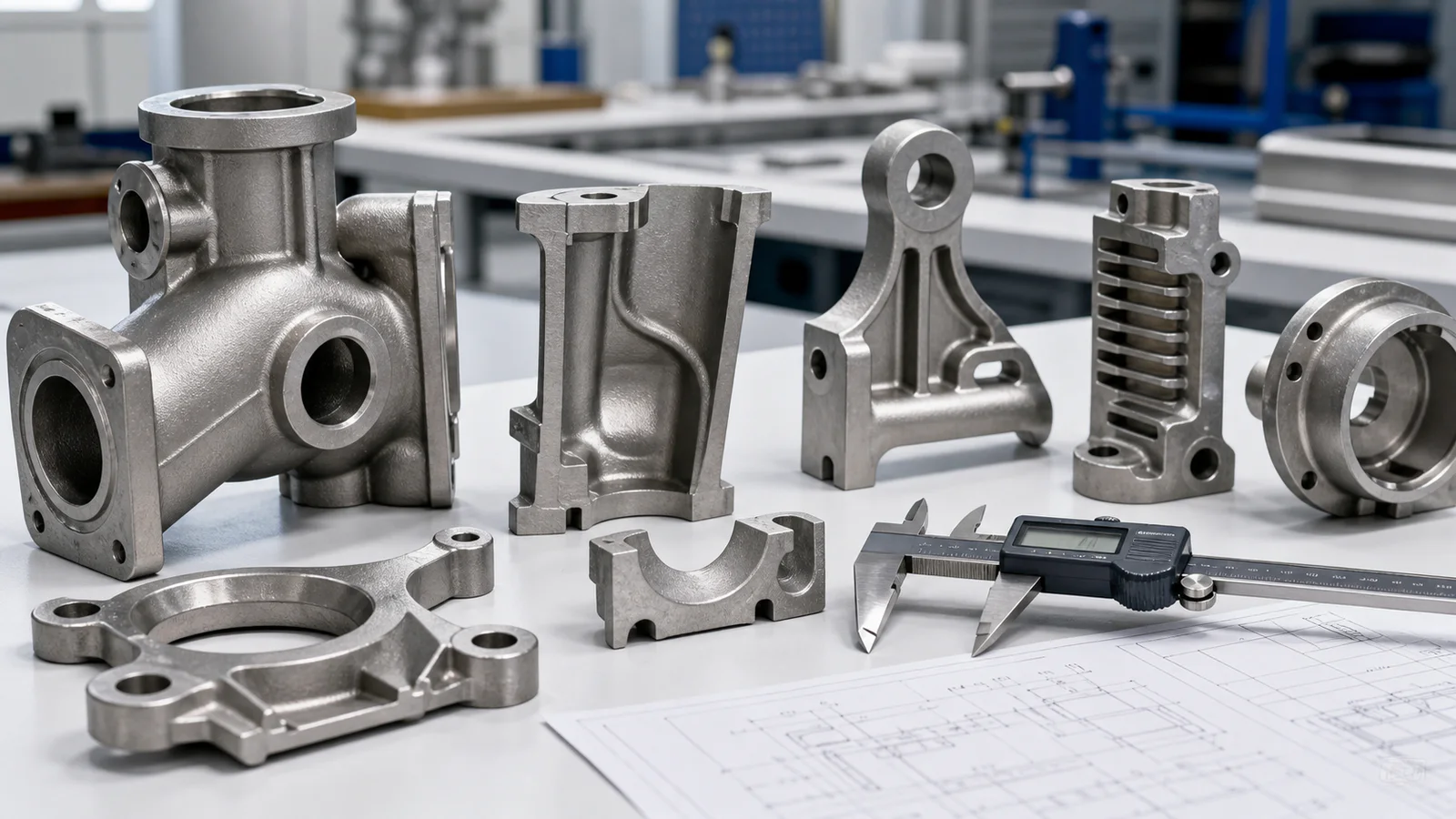
When designing stainless steel precision castings, the question of "what is the minimum wall thickness that can be achieved" is asked in almost every lightweight, complex structure, and small part project. A very small limit number can often be found online, but if the material, flow distance, part size, internal cavity, and process location are ignored, and this number is directly written into the whole part drawing, it is easy to cause under-casting, cold shut, deformation, or dimensional instability during mass production.
To state the conclusion first:Investment CastingThere is no uniform minimum wall thickness applicable to all parts.The achievable values for localized, short-distance thin-walled specimens are not equivalent to the wall thicknesses that can be stably mass-produced for long flow channels, large-area shells, or complex internal cavities. The design goal should be "reproducibility while meeting functional requirements," rather than pursuing the extreme values presented in promotional materials.
What factors determineMinimum wall thickness for precision casting?
1. Flow and solidification properties of alloys
Different types of stainless steel, carbon steel, heat-resistant steel, and duplex steel have different casting temperatures, fluidities, solidification methods, and heat treatment requirements. Changing the material for the same structure may result in a different minimum stable wall thickness; therefore, the material system must be confirmed before design review.
2. Length and area of the thin-walled region
A short, thin section near the gate presents a different challenge than a long, thin wall far from the gate. As metal flows through the mold, it continuously dissipates heat; the longer the flow distance and the narrower the cross-section, the more difficult it is to complete the filling. The risk increases further if the thin wall also features sharp turns, branching, or large-area expansion.
3. Overall dimensions and heat distribution of the parts
Thin walls on small parts are generally easier to control than the same wall thickness on large housings. If a thin wall is connected to a thick flange, boss, or hot spot, the difference in cooling rate can also cause shrinkage, stress, and deformation.
4. Pouring direction, gating point, and venting conditions
The same set of geometries may have different filling capacities depending on the arrangement of the molding trees and the pouring direction. The final pouring scheme is determined by the foundry based on the wax patterns, shell making, and equipment capabilities, so it is valuable to conduct a manufacturability review before the drawings are finalized.
5. Batch size, quality requirements, and process capability
“"Occasionally producing a sample" and "consistently delivering each batch" are two different things. The design must also consider dimensional tolerances, deformation correction, appearance quality, testing costs, and acceptable yield rates. For critical load-bearing or assemblies, more stable structural windows should be prioritized.
SFSA's publicly available design data indicates that investment casting can achieve thinner cross-sections, but the minimum cross-section is still affected by length, metal flow, and structure. Investment casting industry data also recommends that designers and casting engineers jointly determine the specific dimensions for each part, rather than simply copying table values.
It's more important to make the wall thickness as uniform as possible than simply making it thinner.
Uniform wall thickness facilitates smooth metal filling and more synchronous solidification in different areas, and also reduces local hot spots, shrinkage cavities, and deformation. When functionally permissible, abrupt transitions from thin to thick walls over a very short distance should be avoided.
If strength or connection requires localized material additions, gradual transitions, appropriate rib placement, hollowing out, or structural redistribution can be used instead of directly piling up a thick metal block. For the junctions of flanges, bosses, and shells, the actual thickness formed by the superposition of multiple sections should also be checked.
How should the transition between thick and thin sections be handled?
- Use a gentle, gradual transition:Increase or decrease the cross-section gradually to avoid sudden steps;
- Check the intersection:The intersection of two walls, ribs, and protrusions may become a hidden hot spot;
- Appropriate localized weight loss:For thick, non-functional areas, consider hollowing them out or redistributing the materials.
- Leave a purposeful allowance for the machined surface:Add the allowance only to the areas where cutting is required, and avoid making the entire part thicker.
- Combined with the direction of compensation:The structure should support orderly solidification and feeding as much as possible, rather than forming isolated hot zones.
Are you designing a precision casting?You can submit 2D drawings or 3D models, indicating materials, key dimensions, and estimated quantities. Haijin can combine...Silica sol precision casting与CNC MachiningConditions, including wall thickness, fillets, holes, and machining references.
Rounded corners are not merely decorative; they are an integral part of casting and load-bearing.
Sharp inner corners can hinder smooth metal flow and create stress concentrations and the risk of thermal cracking; sharp outer edges are also detrimental to wax molds, mold shells, and subsequent use. Appropriate rounded corners should generally be designed at the junctions of walls, ribs and the main body, and bosses and shells.
However, larger fillets are not always better. If the inner fillet is too large, it may create a new thick area when superimposed on the adjacent thick wall. The size of the fillet needs to be considered in conjunction with the thickness of the adjacent wall, the available space, the stress, and the casting conditions to maintain a continuous profile and a smooth change in cross-section.
What should be considered when designing holes, slots, and blind cavities?
Through hole
The diameter, depth, and orientation of the hole affect whether it can be cast directly. Slender holes place higher demands on core strength, mold shell, metal flow, and cleaning. If the dimensional tolerances, coaxiality, or surface roughness of the hole are strict, it is usually more suitable to first cast the guide hole or solid blank, and then complete the hole through drilling and boring.
Blind holes and deep grooves
Deep blind holes and narrow slots can cause difficulties in waxing, core forming, mold shell cleaning, and can also restrict venting. The design should assess whether to convert them to through holes, increase the opening size, shorten the depth, or use post-processing as an alternative.
cross holes
Cross-flow channels are commonly found in valve bodies and hydraulic components. It's necessary to consider the core positioning, interface thickness, cleaning accessibility, and sealing requirements simultaneously. For pressure-bearing structures, the inspection and sealing methods must also be clearly defined.
How can bosses and reinforcing ribs be designed more effectively?
Bosses are used for mounting, drilling, or threading, while reinforcing ribs are used to improve rigidity. They should be designed to connect smoothly to the main body, avoiding sudden thickening at the base. The thickness of the ribs should be proportionate to adjacent walls; excessively high, thick, or isolated bosses can lead to localized thermal spots and deformation.
For process bosses used only for CNC positioning, the minimum effective size and whether they need to be removed later can be confirmed with the machining personnel. This ensures proper clamping and avoids leaving excess weight on the finished product.
Six common mistakes in minimum wall thickness design
- It only considers the local wall thickness, ignoring the thin-wall length and the metal flow path;
- To reduce weight, the entire large-area shell was changed to the same extremely thin value;
- A thick flange or solid boss is directly connected to the side of the thin-walled part;
- Sharp corners are used for internal corners, rib roots, and slots;
- All the fine holes requiring high precision must be cast in one go;
- The foundry was only allowed to evaluate the structure after the mold was completed, which led to repeated mold modifications.
Structural review checklist before mold making
- Are the material grade and implementation standards clearly defined?
- What are the location, length, and area of the thinnest region?
- Is there a sudden change in thickness or an intersection of multiple sections?
- Whether the inner and outer rounded corners are continuous and whether new hot spots are formed;
- Can holes, grooves, and cavities be formed, dewaxed, and cleaned?
- Are there any unnecessary material accumulations at bosses, ribs, and flanges?
- Which surfaces remain in the cast state, and which areas require CNC machining?
- Are the clamping datum, key tolerances, and inspection methods feasible?
- Is it permissible to adjust the mold based on the actual measurement results after the first piece?
If the drawings are still in the design phase, early communication is usually more time-efficient than making modifications after mold making. (Haijin)Custom Stainless Steel Castings PageThe scope of the evaluation based on the provided drawings has been explained.Quality control pageYou can learn about common dimensions and appearance inspection items.
Frequently Asked Questions
Can stainless steel precision casting achieve a wall thickness of less than 1 mm?
While certain materials, short distances, and small structures may allow for the manufacture of very thin cross-sections, this does not necessarily mean that any part can be stably mass-produced. Confirmation needs to consider the thin-wall length, area, casting location, quality requirements, and the supplier's actual process capabilities.
Does a more uniform wall thickness necessarily mean that the casting is free of defects?
Uniform wall thickness can reduce some risks, but casting quality is also affected by materials, gating systems, molds, melting, temperature, feeding, and operational control. A rational structure is an important foundation for stable manufacturing, but not the only condition.
Is it cheaper to cast small holes directly or to process them later?
The cost depends on the hole diameter, depth, quantity, tolerances, and location. Casting holes can reduce material and drilling, but may increase the difficulty of molds or cores; high-precision deep holes usually still require machining. The overall process cost should be compared, not just the cost of individual steps.
The design goal is not to achieve the thinnest possible thickness, but to ensure stable delivery.
Precision casting can achieve complex structures and near-net-shape finishes, but truly valuable designs strike a balance between weight, strength, casting stability, CNC machining, and procurement costs. When determining the minimum wall thickness, the entire part should be evaluated as a thermal and flow system.
Submit drawings for wall thickness and structural manufacturability assessmentYou can also enterContactThe page provides information on materials, quantity, and usage requirements via WeChat, phone, or email.
References
This article references publicly available casting design materials from the Steel Founders' Society of America and precision casting design materials published by the Investment Casting Institute. No guaranteed values are provided outside of specific structures; actual capabilities should be verified by the manufacturer based on part and batch specifications.
SFSA: Ordering Steel Castings
SFSA: Conceptual Framework for Designing Metal Castings
Investment Casting Institute:Investment Casting Design Information
Relevant technical information and product examples
Continue to assess whether the materials, workmanship, and actual parts are suitable for your procurement needs.
- Process ComparisonHow to choose between silica sol process and water glass process?→
- Process ComparisonWhat are the differences between precision casting and powder metallurgy?→
- Quality requirementsPrecision casting surface roughness and polishing treatment→
- Product ExamplesCNC machining of industrial and mechanical parts casting→
Manufacturing process evaluation
We need to determine which manufacturing process is suitable for this part.
Please provide the structure, material, quantity, key dimensions, and surface requirements. We will conduct an evaluation based on precision casting, post-processing, CNC machining, and inspection.
- Assess wall thickness, fillet radius, and molding risks.
- Confirm casting allowance and post-machining location
- Select process based on quantity, quality and delivery time.