










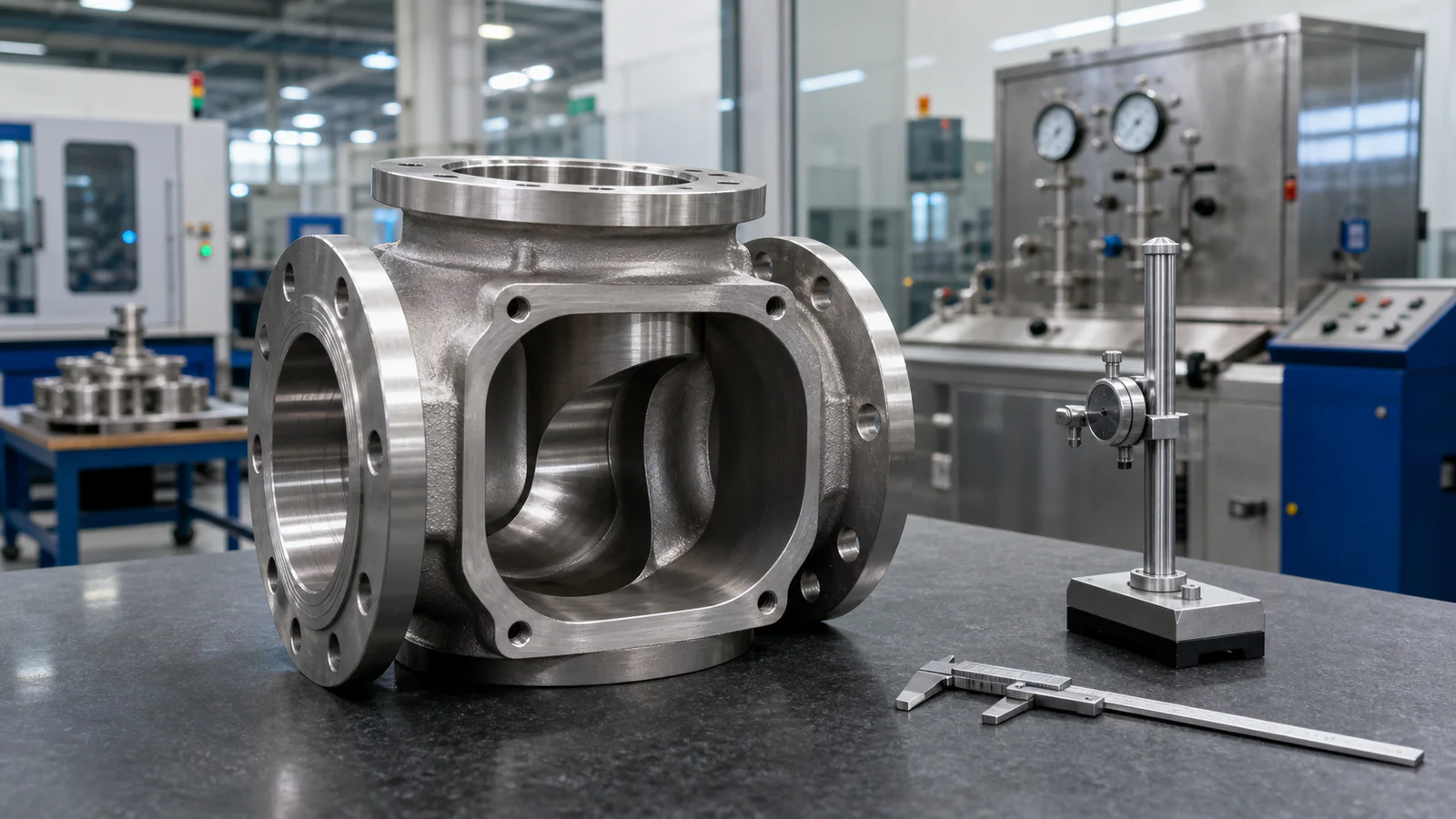
A stainless steel valve body may appear to be just a shell with flow channels, flanges, and mounting holes, but it simultaneously serves the functions of media transport, sealing, connection, and pressure bearing. When purchasing valve body castings, if only prices are quoted based on weight and material, the filling of the flow channels, thickness transitions, machining of the sealing surfaces, hole position relationships, and inspection standards are often overlooked. Ultimately, this may result in a situation where the blank can be cast, but it cannot be stably machined or pass assembly acceptance.
Valve body precision castingThe correct starting point is to first confirm the operating conditions and finished product functions, and then work backward to determine the materials, casting structure, CNC machining, and inspection plan.For pumps, valves, chemical fluid equipment, food machinery, and general industrial piping parts, this is more important than simply specifying "304 or 316".
Why are stainless steel valve bodies suitable?Investment Casting?
Silica sol investment casting is suitable for small to medium-sized valve bodies with curved flow channels, flanges, bosses, mounting ears, and irregular outer contours. With proper design, multiple structures can be formed in one step, reducing welding and extensive machining, while allowing for post-machining of sealing surfaces, valve stem holes, flange end faces, and threads.
However, "suitable for precision casting" does not mean that all structures can be produced exactly as they are. Deep cavities, narrow runners, isolated thick areas, excessively thin long walls, and blind cavities that are difficult to clean still require adjustments based on the casting direction, core design, wax pattern, shell making, and pouring conditions.
Please provide information on 5 types of valve body operating conditions before providing a quote.
- medium:Water, seawater, steam, food fluids, acids, alkalis, or other chemical media;
- Temperature and pressure:Scope of work, whether there are impacts or frequent start-ups/shutdowns;
- Connection method:Flange, thread, welded end, or other interface types;
- Implementation Standard:Standards for materials, dimensions, valves, non-destructive testing, and pressure testing;
- Scope of procurement:Even with just a casting blank, CNC machining, surface treatment, and finished product inspection are still required.
Valve standards such as ASME B16.34 cover requirements for materials, dimensional tolerances, non-destructive testing, examination, and marking, but not every valve body uses the same standard. Specific requirements should be based on customer drawings, contracts, and applicable industry specifications.
Valve body material cannot be confirmed verbally based solely on "304" or "316".
304, 316, and 316L are common material designations used in procurement. When it comes to casting manufacturing, it's necessary to confirm the corresponding casting grade and applicable standards. For example, CF8 is often used as a reference for 304-class stainless steel castings, CF8M is often used as a reference for 316-class, and low-carbon molybdenum-containing castings usually require further verification of requirements such as CF3M. For seawater or high-chlorine media, duplex or super duplex stainless steels may also be evaluated.
Material selection should comprehensively consider the medium, temperature, pressure, corrosion form, welding, and testing requirements. Grade comparison can only aid communication and cannot replace confirmation based on drawings and standards. If material reports, furnace number traceability, spectral analysis, mechanical property testing, or corrosion testing are required, this should also be specified during the quotation stage.
The flow path, wall thickness, and fillet radius determine whether the valve body is easy to cast stably.
1. The flow channel should balance the properties of the liquid and the accessibility of casting.
The valve body cavity must meet the requirements for flow rate and pressure drop, while also considering whether wax molding, core making, shell making, dewaxing, and cleaning can be achieved. Narrow, blind cavities, sudden contractions, or locations where sand removal and cleaning are difficult may increase the risk of incomplete filling, inclusions, or residues.
2. The transition between thick and thin sections should be as smooth as possible.
Localized thick hot spots can easily form at the intersections of flanges, valve seats, bosses, and the shell. Sudden changes in thickness can cause asynchronous cooling in different areas, increasing the risk of shrinkage cavities, porosity, deformation, and thermal cracking. These issues can be mitigated in the design by using gradual transitions, appropriate fillet fillets, localized weight reduction, and process-induced shrinkage compensation.
3. Sharp corners should be replaced with appropriate rounded corners.
Sharp inner corners hinder metal flow and easily lead to stress concentration. The size of the fillet radius should not be determined by a fixed ratio, but rather by considering wall thickness, space, stress, and mold conditions. The key is to avoid abrupt changes and to prevent creating new localized thick areas due to excessively large fillets.
4. Bosses and reinforcing ribs must truly serve their function.
Bosses or reinforcing ribs are often provided at valve stem holes, bolt holes, and mounting locations. These should have sufficient rigidity, but should also avoid overlapping with the housing to form an excessively thick cross-section. If the only requirement is for machining positioning, a smaller process table or specialized fixture can be evaluated.
There are valve bodies, pump bodies orimpellerdrawing?It is possiblePrecision casting of pump and valve partsView the processing range on the page, or directly...Submit drawings, materials, quantities, and working conditions.Conduct process and quotation evaluation.
These locations typically require CNC precision machining.
- Valve seat and sealing surface:Control flatness, roundness, coaxiality, and surface roughness;
- Valve stem bore and shaft bore:Ensure the orifice diameter, position, and relationship with the sealing surface;
- Flange face and stop:Meets connection, sealing, and assembly dimensions;
- Threads and bolt holes:Complete drilling, tapping, countersinking, and hole spacing control according to specifications;
- Mating surfaces and locating surfaces:As a stable benchmark for subsequent assembly and testing.
The difficulty in machining valve bodies lies not only in a single dimension, but also in the datum relationships between multiple sealing surfaces, holes, and flanges. During drawing review, the machining datum, clamping sequence, and inspection methods should be determined first, and then the blank allowance should be set. If the mold is made first and then the clamping method is considered, it often increases the cost of specialized tooling and calibration.
How should common quality inspections of valve body castings be arranged?
Material and furnace batch confirmation
Verify the chemical composition, material grade, and heat treatment status according to the order requirements. When traceability is required, the furnace number, material certificate, and marking method should be clearly specified.
Appearance and Dimension Inspection
Inspect the cleaning of the gating system, surface defects, deformation, and key blank dimensions; after machining, verify the dimensions and positional requirements of the sealing surfaces, holes, threads, and flanges.
Nondestructive testing
Penetrant testing is suitable for detecting surface opening defects, while radiographic testing can be used to assess internal conditions. However, the testing methods, locations, sampling ratios, and acceptance levels should be determined according to the drawings or agreed standards. Not all valve bodies require the same testing combination.
Pressure and sealing test
Pressure-bearing valve bodies may require shell pressure testing or sealing testing. The test medium, pressure, holding time, temperature, clamping and plugging, and acceptance criteria must be derived from applicable specifications or customer requirements, and cannot be replaced by a generic parameter adopted by the foundry.
HaijinQuality control pageCommon dimensions, appearance, and shipping inspection items are listed. Items involving pressure resistance or specialized non-destructive testing should be specifically indicated in the inquiry documents.
Valve Body Precision Casting Inquiry List
- 2D finished product images, 3D models, and drawing versions;
- Material grade, applicable standards, and heat treatment requirements;
- Medium, temperature, pressure, and corrosive environment;
- Key sealing surfaces, hole positions, tolerances, and surface roughness;
- Non-destructive testing, pressure testing, and documentation requirements;
- Weight per piece, initial quantity, estimated annual usage, and delivery date;
- Raw material delivery may include CNC machining, surface treatment, and packaging.
Frequently Asked Questions
Can the valve body be purchased using only a precision-cast blank?
Yes, but it's recommended to first confirm the benchmarks, allowances, and testing requirements of the subsequent processing plant. Having the same supplier handle both casting and CNC machining makes it easier to standardize the blank structure, clamping, and responsibility for critical dimensions.
Can you provide a quote without a complete pressure testing standard?
A preliminary process assessment can be conducted first, but the testing basis, pressure, holding time, acceptance and document requirements need to be confirmed before formal quotation and production. Otherwise, different testing calibers will cause significant cost differences.
Is a 316 stainless steel valve body always more suitable than a 304 stainless steel one?
Not necessarily. 316-class materials generally have better specific corrosion resistance, but whether they are needed depends on the medium, concentration, temperature, lifespan, and cost. In harsh chloride environments, 316 may also be insufficient.
Standardize casting, machining, and testing requirements before mold opening.
Stable valve body delivery stems from a complete engineering chain: first, understanding the operating conditions and standards; then assessing flow channels, wall thickness, materials, and casting risks; and finally, determining machining benchmarks and acceptance methods. Haijin Stainless Steel can evaluate silica sol precision casting, CNC post-machining, and inspection solutions for stainless steel valve bodies, pump bodies, impellers, and other fluid equipment parts based on drawings.
Submit valve body drawings to obtain process and quotation suggestionsYou can also enterContactThe page allows communication via WeChat, phone, or email.
References
The technical principles outlined in this document are based on the ASME B16.34 valve standard and publicly available design and inspection data for steel castings from the Steel Founders' Society of America. Specific product specifications should be based on applicable standards, customer drawings, and mutually agreed-upon documents.
ASME B16.34: Valves—Flanged, Threaded, and Welding End
SFSA: Steel Casting Specifications
Relevant technical information and product examples
Continue to assess whether the materials, workmanship, and actual parts are suitable for your procurement needs.
- Material selectionCommonly used precision casting material grades for water pump impellers→
- Application AnalysisApplication of precision casting in water pump impeller manufacturing→
- Defect controlApplication and Defect Control of Water Pump Head Casting→
- Product ExamplesPrecision casting and CNC machining of valve and pump impellers→
Pump and valve component process evaluation
Do you have drawings of impellers, valve bodies, or pump bodies that need to be evaluated?
Haijin can evaluate precision casting and CNC post-machining solutions by considering corrosion resistance requirements, flow channel structure, wall thickness, sealing surface, and key mating dimensions.
- Material orientation is determined based on medium and temperature.
- Assess the risks of flow channels, wall thickness, and casting defects.
- Confirm the machining of sealing surfaces, hole positions, and mating dimensions.