









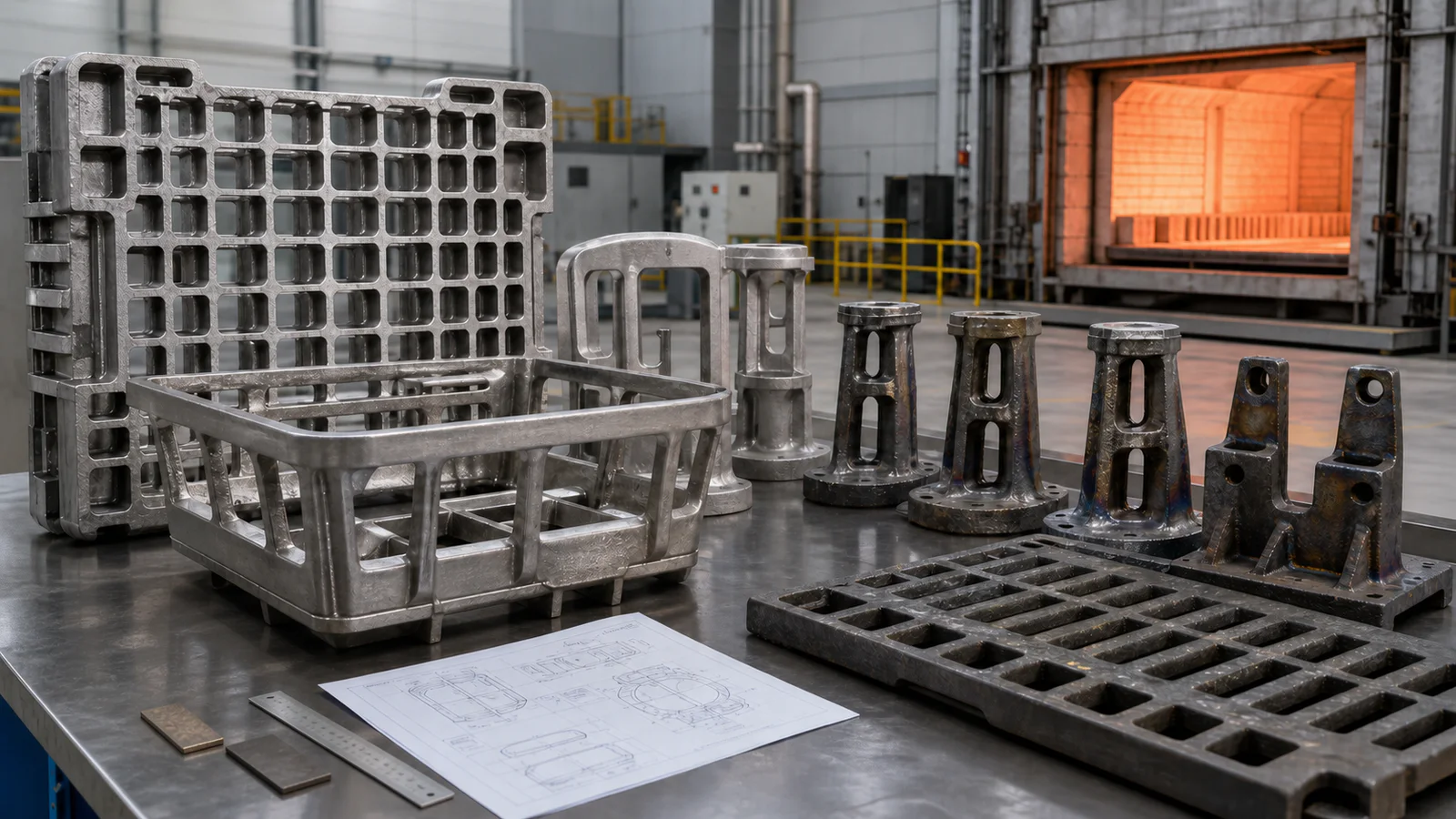
When procuring furnace bottom plates, heat treatment trays, material frames, furnace guide rails, burner components, and high-temperature support parts, the drawings may show different grades such as HK40, HP40, SCH, GX40CrNiSi25-20, 1.4848, ZG40Cr25Ni20, 310S, or 2520. These grades originate from different standard systems in the United States, internationally, Europe, Japan, and China. While some have similar compositional orientations, they...Similar brand names do not mean they can be directly substituted.。
This article compiles the grades of heat-resistant steel and heat-resistant alloy castings from major global standards to help purchasing and engineering personnel initially identify material systems. The content covers ASTM A297, ISO 11973, European standard material names and designations, JIS SCH series, and Chinese standards.GB/T 8492And the HK40, HP40 and 310S/2520 that are commonly referred to in the industry.
Important Disclaimer:This comparison table is for quotation inquiries, drawing identification, and preliminary material selection only. It does not constitute proof of material equivalence, approval of substitution, design basis, or guarantee of service life. "Similar" and "Reference Substitute" in the table only indicate that the nominal composition or material system may be similar; they do not represent identical chemical composition, carbon content, casting method, heat treatment, microstructure, creep properties, endurance strength, weldability, or acceptance requirements. Any formal substitution must be verified against the latest version of the applicable standard, complete composition, and performance requirements, and must be confirmed in writing by the designer, purchaser, and manufacturer.
What standards are mainly used for heat-resistant steel castings worldwide?
| system or region | Common standard or grade forms | Procurement Identification Focus |
|---|---|---|
| ASTM/ACI (American Society for Testing and Certification) | ASTM A297/A297M; HF, HH, HI, HK, HL, HN, HT, HU, HW, HX, etc. | Confirm the grade, carbon content, product form, and additional performance requirements for the order. |
| International ISO | ISO 11973:2023; GX, G-Ni, G-Co series | Specification of chemical composition and mechanical properties of general-purpose heat-resistant cast steels and alloys |
| European EN style designation | Material numbers GX40CrNiSi25-20, GX40NiCrSiNb35-26, and 1.xxxx and 2.xxxx | The name can be read to approximate the composition, but the material number and standard version still need to be checked. |
| Japan JIS | SCH series in JIS G 5122 | The drawings should simultaneously confirm the SCH grade, standard year, and additional acceptance requirements. |
| China GB | GB/T 8492-2024; ZGCrSi, ZGCrNiSi and heat-resistant alloy castings | The 2024 version has replaced GB/T 8492-2014, and the continued use of obsolete versions should be avoided. |
| Enterprise or industry brand | HK40, HP40 (improved), Nb (improved), and microalloyed grades | You can't just look at the product name; you must obtain the company's technical specifications and ingredient range. |
In addition to the general systems mentioned above, petrochemical furnace tubes, pressure components, exhaust manifolds, cement equipment, and power equipment may also use specialized product standards. This article cannot exhaustively list the internal grades of every country, industry, and company; when purchasing, the standards specified in the drawings should be the primary basis.
Global Comparison Table of Commonly Used Heat-Resistant Cast Steel Grades
The table below is primarily based on ISO heat-resistant cast steel designations, supplemented by European material designations and similar UNS designations listed in publicly available information. "Similar UNS" uses the standard's terminology and should not be interpreted as automatic equivalence.
| Material system | ISO/EN designations | Material number | Similar UNS references | Preliminary material selection direction |
|---|---|---|---|---|
| Chromium-silicon type | GX30CrSi7 | 1.4710 | — | Medium temperature, primarily using chromium and silicon for oxidation resistance |
| Chromium-silicon type | GX40CrSi13 | 1.4729 | J91153 | Nickel-free or low-nickel heat-resistant casting direction |
| Chromium-silicon type | GX40CrSi17 | 1.4740 | — | High-chromium oxidation-resistant castings |
| Chromium-silicon type | GX40CrSi24 | 1.4745 | — | High-chromium, nickel-free heat-resistant direction |
| Chromium-silicon type | GX40CrSi28 | 1.4776 | J92605 | Higher chromium oxidation resistance direction |
| High-carbon chromium silicon type | GX130CrSi29 | 1.4777 | — | High carbon and high chromium content require close verification of brittleness and operating conditions. |
| Chromium-nickel type | GX25CrNiSi18-9 | 1.4825 | J92803 | 18Cr-9Ni grade heat-resistant castings |
| Chromium-nickel type | GX25CrNiSi20-14 | 1.4832 | — | Directions for increasing nickel content to improve heat resistance |
| Chromium-nickel type | GX40CrNiSi22-10 | 1.4826 | J92803 (similar) | High carbon chromium nickel heat resistant direction |
| 25Cr-12Ni type | GX40CrNiSi25-12 | 1.4837 | J93503 | Often compared with HH type material systems |
| 25Cr-20Ni type | GX40CrNiSi25-20 | 1.4848 | J94204 | Often compared with HK40 material system |
| High chromium, low nickel type | GX40CrNiSi27-4 | 1.4823 | J93005 | High chromium, low nickel direction |
| Niobium Improved | GX40CrNiSiNb24-24 | 1.4855 | — | High-temperature load-bearing direction reinforced by Nb |
| Low-carbon niobium stabilized | GX10NiCrNb32-20 | 1.4859 | N08151 | Low carbon, Ni-Cr-Nb heat-resistant direction |
| High nickel type | GX40NiCrSi35-17 | 1.4806 | N08002 | Improve nickel content and high temperature stability |
| 35Ni-26Cr type | GX40NiCrSi35-26 | 1.4857 | N08705 | Often compared with HP-type high-nickel heat-resistant materials |
| HP-Nb direction | GX40NiCrSiNb35-26 | 1.4852 | — | Nb-modified 35Ni-26Cr grade direction |
| High nickel type | GX40NiCrSi38-19 | 1.4865 | N08004 | 38Ni-19Cr grade heat-resistant direction |
| High nickel niobium type | GX40NiCrSiNb38-19 | 1.4849 | N08008 | Nb-modified high-nickel heat-resistant direction |
| Nickel-based casting alloys | G-NiCr28W | 2.4879 | — | Ni-Cr-W high-temperature alloy direction |
| Nickel-based casting alloys | G-NiCr50Nb | 2.4680 | R20501 | High chromium nickel-based and Nb-containing orientation |
| Nickel-based casting alloys | G-NiCr19 | 2.4687 | — | Nickel-chromium alloy casting direction |
| Nickel-based casting alloys | G-NiCr15 | 2.4815 | N06006 | Nickel-based heat-resistant and corrosion-resistant alloys |
| Complex reinforced alloys | GX50NiCrCoW35-25-15-5 | 1.4869 | — | Ni-Cr-Co-W composite strengthening direction |
| Cobalt-based casting alloy | G-CoCr28 | 2.4778 | — | Cobalt-chromium superalloy direction |
How to use this table:First, use the drawing designations to determine the general material system, then confirm the applicable standards, standard year, product type, and acceptance criteria with the client. Do not generate procurement designations directly from the "preliminary material selection direction," and do not treat similar UNS designations as identical materials.
What do the letters HF, HH, and HK mean in ASTM A297?
ASTM A297/A297M covers general-purpose iron-chromium and iron-chromium-nickel heat-resistant alloy castings. Common grades include HF, HH, HI, HK, HE, HT, HU, HW, HX, HC, HD, HL, and HN. In the industry, carbon content is often added after the letters to form designations such as HK40, but formal procurement should specify the complete standard and grade.
- HF, HH, etc.:It belongs to a family of heat-resistant casting materials with different chromium-nickel ratios;
- HK40:This usually refers to cast heat-resistant steel with a carbon content of approximately 25Cr-20Ni.
- HP40:In the industry, this usually refers to the direction of casting heat-resistant materials with higher nickel content, such as 25Cr-35Ni, commonly modified with Nb, Ti, etc.
- Improved grade:Even if they are all labeled HP40, the requirements for Nb, Ti, W, or microalloying may differ, and the complete enterprise specifications must be obtained.
ASTM uses different standards for general-purpose castings, centrifugal cast pipes, and specific high-temperature products. When you see "HP" or "HK," you should also confirm that the part is a statically cast part.Investment CastingIt is still centrifugal casting, and the actual use of A297, A447, A560, A608 or other product standards.
Can HK40, HP40, 310S and 2520 be substituted for each other?
| Common names | Typical identity | Comparison directions can be used as a reference. | Alternative conclusions |
|---|---|---|---|
| 310S / 2520 | Common names for forged and rolled stainless steel; 06Cr25Ni20 is commonly used in China. | Compared with the 25Cr-20Ni material system | It cannot directly replace casting grades such as HK40 |
| HK40 | 25Cr-20Ni grade high carbon heat-resistant casting materials | Similar systems include GX40CrNiSi25-20, 1.4848, and J94204. | Standards and ingredients need to be checked item by item. |
| HP40 | Approximately 25Cr-35Ni grade high carbon heat-resistant casting materials direction | GX40NiCrSi35-26 and its Nb-modified form, etc. | The standard and improved versions cannot be used interchangeably. |
| ZG40Cr25Ni20 type | Chinese-style heat-resistant cast steel grade direction | HK and 25Cr-20Ni type material systems | Acceptance must be carried out in accordance with GB or agreed enterprise standards. |
310S is a common designation for forged and rolled products such as plates, bars, and tubes, while HK40 and HP40 belong to the context of cast heat-resistant materials. Even with similar main chromium-nickel ratios, carbon content, silicon, microstructure, carbides, high-temperature creep performance, and manufacturing methods can still differ significantly. Especially for furnace charge pans and supports that bear heavy loads for extended periods, room temperature composition cannot be compared alone.
Do I need to verify the grade HK40, HP40, SCH, or GX on the drawings?Material standards, operating temperature, furnace atmosphere, load, thermal cycle, and part drawings can be submitted together. Haijin can combine...Custom heat-resistant steel castings与Investment CastingA preliminary process assessment was conducted based on the available conditions.
Which standard should be adopted for heat-resistant steel castings in China?
The current general standard in China isGB/T 8492-2024 General Purpose Heat-Resistant Steel and Alloy CastingsThe new standard has completely replaced GB/T 8492-2014. Publicly available standard information shows that the new version covers general-purpose heat-resistant steel and heat-resistant alloy castings, and involves grades, technical requirements, inspection, dimensional tolerances, machining allowances, welding repairs, non-destructive testing, and delivery.
Common Chinese alloy grades include chromium-silicon series such as ZG30Cr7Si2, ZG40Cr13Si2, ZG40Cr17Si2, ZG40Cr24Si2, and ZG40Cr28Si2, as well as chromium-nickel and heat-resistant alloy series. When placing an order, the complete grade should be verified against the current standard text; the composition should not be copied from old online tables.
How to handle JIS SCH series and European material numbers?
Japanese heat-resistant steel casting drawings often use the SCH series from JIS G 5122. European and ISO systems commonly use grade names starting with GX and material numbers like 1.xxxx or 2.xxxx. The GX designation reflects the main alloying directions such as carbon, chromium, nickel, silicon, and niobium, but the name cannot replace the upper and lower limits of composition and performance requirements in the standard.
When receiving JIS or European drawings, it is recommended to retain the customer's original grade designation and not translate them into "310S" or "HK40" before handing them over to the factory. The correct procedure is to pass the original standard, grade designation, and version to the production and testing personnel, and then propose a written alternative for the Chinese-supplied grade designation or materials.
The selection of materials for heat-resistant castings should not be based solely on the highest temperature.
- Furnace atmosphere:Oxidation, reduction, carburization, and sulfur- or nitrogen-containing environments have different effects on materials;
- Load-bearing method:The performance requirements for static insulation components and long-term load-bearing trays differ.
- Thermal cycling:Frequent temperature fluctuations may cause thermal fatigue and deformation to become the main causes of failure.
- Structure and wall thickness:Large-area grids, ribs, and abrupt changes in thickness can affect casting and deformation during use;
- Casting process:Precision casting, sand casting, and centrifugal casting are applicable to different products and have different microstructures.
- Machining and Welding:The machining and welding requirements for high-carbon heat-resistant cast steel cannot be directly applied to those for ordinary stainless steel.
- Acceptance items:Chemical composition, dimensions, non-destructive testing, room temperature performance, and high temperature durability should be determined according to the application.
For heat treatment trays and frames, the loading weight, support points, furnace loading method, maximum and normal operating temperatures, holding time, and heating/cooling frequency must also be provided. Haijin currently has...Heat-resistant steel heat treatment tray和Heat-resistant steel heat treatment material frameThis page can be used as a reference for the product structure.
Correct confirmation process for material substitution
- Preserve the original standards, grades, and standard years on the customer's drawings;
- Obtain the complete chemical composition range of the original and candidate grades;
- Verify the casting method, heat treatment, metallographic structure, and grain requirements;
- Compare room temperature mechanical properties and applicable creep, stress, oxidation, or thermal fatigue data;
- Confirm welding, machining, non-destructive testing, and dimensional acceptance requirements;
- Risk assessment should be conducted by taking into account actual temperature, atmosphere, load, and service life.
- Production should only resume after written approval from the designer or end user for a replacement.
Material Comparison and Alternatives Disclaimer
This article summarizes the major global standards and common industry grades, but it cannot cover all national standards, industry standards, patented materials, and internal company alloys. Even if the grade names or nominal compositions are similar, different standards may differ in terms of carbon, silicon, niobium, titanium, tungsten, cobalt, impurity control, heat treatment, casting methods, and performance testing.
Haijin Stainless Steel does not recommend that customers directly substitute materials based solely on the online grade comparison table.This document assumes no responsibility for design, procurement, and usage risks arising from material substitutions not confirmed by the designer, exceeding the applicable working conditions of materials, incorrect standard versions, or incomplete information. For pressure-bearing, safety-critical, long-term high-temperature load-bearing, and special atmosphere projects, material selection and verification should be completed by qualified material and design personnel.
Frequently Asked Questions
What Chinese trademark does HK40 correspond to?
In engineering communications, HK40 is often compared with 25Cr-20Ni casting material systems such as ZG40Cr25Ni20, GX40CrNiSi25-20, 1.4848, or UNS J94204. However, these can only serve as references, and the formal correspondence must be verified item by item according to the standard text and order requirements.
What are the main differences between HP40 and HK40?
HP40 typically has a higher nickel content than HK40 and often incorporates Nb and Ti modifications to improve specific high-temperature load-bearing capacity and microstructural stability. The two are not simply a matter of superiority or inferiority; the choice should be made based on temperature, atmosphere, load, and relevant standards.
Can the 310S replace the HK40 in making furnace feed trays?
310S and HK40 cannot be directly substituted based solely on their approximate designations (e.g., 25Cr-20Ni). They belong to different product and material contexts, and their carbon content, microstructure, and high-temperature performance requirements may differ. A reassessment is necessary, taking into account factors such as tray load, temperature, thermal cycling, and lifespan requirements.
Is spectral analysis alone sufficient for a materials report?
Spectroscopic analysis can identify the main chemical composition, but it cannot independently prove heat treatment, microstructure, high-temperature creep performance, or actual lifespan. For critical heat-resistant castings, dimensions, appearance, non-destructive testing, mechanical properties, or high-temperature performance should also be determined according to the contract.
Submitting these documents will allow for a more accurate selection of heat-resistant casting materials.
When requesting a quote, it is recommended to provide 2D drawings or 3D models, original material standards and grades, operating temperature profiles, furnace atmosphere, load, thermal cycle, dimensional tolerances, testing requirements, initial quantity, and estimated annual usage. The more complete the information, the easier it is to determine whether to use ordinary chromium-silicon heat-resistant steel, HK type, HP type, modified high-nickel cast steel, or nickel-based alloy.
Submit drawings of heat-resistant steel castings and their operating conditions for evaluation.You can also enterContactThe page allows users to send the original trademark number and procurement requirements via WeChat, phone, or email.
Reference standards and materials
This document is compiled based on publicly available information from standards bodies and publicly accessible grade data. It does not reproduce the complete, copyright-protected standard tables. For formal procurement, please purchase or consult the valid version of the relevant standard.
- ISO 11973:2023: Heat-resistant cast steels and alloys for general applications
- ASTM A297/A297M-21a:Heat-resistant steel castings
- GB/T 8492-2024: Heat-resistant steel and alloy castings for general purposes
- Japan Industrial Standards Survey Association (JIS Standards Search)
Relevant technical information and product examples
Continue to assess whether the materials, workmanship, and actual parts are suitable for your procurement needs.
- ResourcesComparison of CF8, CF8M, CF3, CF3M with 304 and 316 grades→
- Material Selection GuideHow to choose between 304, 304L, 316, and 316L stainless steel castings→
- Material comparisonWhat are the differences between CF8 and CF8M?→
- Product ExamplesStainless steel mechanical parts casting and CNC machining→
Material and operating condition confirmation
Unsure which stainless steel casting grade to choose?
Please send us drawings and the usage environment. We will take into account corrosion, temperature, strength, processing, and cost requirements to help us determine the most suitable materials and processes.
- Check common terms and casting standards.
- Determining materials by combining medium, temperature and pressure
- Simultaneous confirmation of heat treatment, testing, and certification documents