











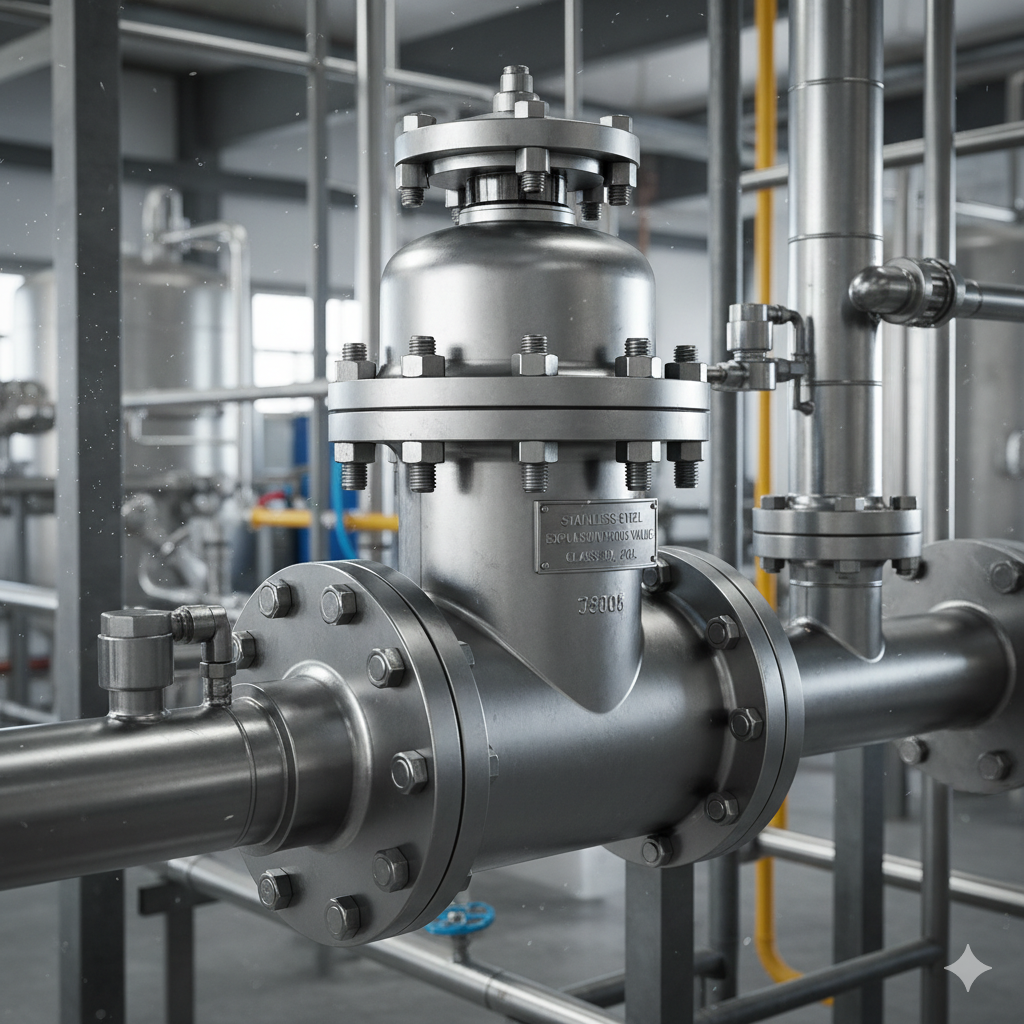
In industrial production, safety is of paramount importance. Explosion-proof valves, as crucial components ensuring production safety, directly impact the stability of the production process and the safety of personnel. Regarding the selection of materials for manufacturing explosion-proof valves, stainless steel is a preferred choice.Investment CastingWith its unique advantages, it is gradually replacing other traditional materials and becoming the industry's first choice.
What is an explosion-proof valve?
An explosion-proof valve, as the name suggests, is a valve used to prevent or mitigate damage to equipment and personnel from explosive shock waves. It is typically installed on containers, pipelines, or equipment where explosions may occur. When the internal pressure abnormally rises to a set value, the explosion-proof valve can quickly open to release excess pressure, thereby preventing an explosion or minimizing its destructive force.
Advantages of stainless steel precision casting
Precision casting of stainless steel is an advanced metal forming process that, through investment casting (lost-wax casting), can produce complex-shaped parts with precise dimensions, smooth surfaces, and dense microstructure. Its advantages are particularly pronounced when this process is applied to the manufacture of explosion-proof valves.
- Excellent corrosion resistance: Explosion-proof valves often operate in environments containing corrosive media, such as in the chemical, petroleum, and pharmaceutical industries. Stainless steel, especially austenitic stainless steel (such as 304 and 316L), has excellent resistance to acid, alkali, and salt corrosion, effectively resisting the erosion of various chemical media and ensuring long-term stable operation of the valve under harsh conditions, greatly extending its service life. In contrast, materials such as carbon steel are prone to rust and corrosion, requiring frequent replacement and maintenance.
- Excellent mechanical properties: Explosion-proof valves need to withstand enormous impact pressure in emergency situations. Stainless steel, with its high strength and toughness, can effectively resist the instantaneous high pressure from an explosion shock wave, and is not prone to deformation or cracking. Precision casting processes can optimize the internal structure of parts, eliminate defects such as sand holes and porosity, and further improve the mechanical properties of castings, making them reliable even under extreme conditions.
- Intricate and complex structure: The internal structure of explosion-proof valves is often complex, containing multiple precision-fitting components such as flow channels, valve seats, and valve covers. Precision casting can mold complex and precise geometries in a single process, requiring little or no subsequent machining, significantly reducing manufacturing costs and time. Furthermore, the high surface finish and smooth internal flow channels of the castings reduce fluid resistance and improve the valve's response speed and pressure relief efficiency.
- Good high/low temperature resistance: Some industrial production environments may involve high-temperature or low-temperature media. Stainless steel maintains stable performance over a wide temperature range, unlike some plastics or rubber materials that soften and deform at high temperatures or become brittle and crack at low temperatures. This allows stainless steel explosion-proof valves to be adapted to a wider range of applications.
- High cleanliness requirements: In industries with stringent cleanliness requirements, such as food and pharmaceuticals, stainless steel's smooth surface, resistance to dirt accumulation, and ease of cleaning and disinfection make it an ideal choice. Precision casting produces parts with high surface quality, further meeting the high cleanliness demands of these industries.
Limitations of other materials
- Carbon steel: It has a low cost, but poor corrosion resistance, is prone to rust, and is not suitable for corrosive environments.
- cast iron: It has low strength and toughness, is brittle and easily cracked, and is not suitable for explosion-proof applications that can withstand high impact pressure.
- Aluminum alloy: It has a low density, but relatively low strength and hardness, and its corrosion resistance is not as good as stainless steel.
- Plastic/Rubber: It is mainly used for sealing components and is not suitable as a material for valve body bodies because its strength and temperature resistance are insufficient.
in conclusion
In conclusion, stainless steel precision casting possesses unparalleled advantages in the field of explosion-proof valve manufacturing due to its superior corrosion resistance, excellent mechanical properties, ability to adapt to complex structures, and stability under extreme temperatures. It not only improves the reliability and service life of explosion-proof valves but also safeguards the safety of industrial production. As industrial demands for safety and efficiency continue to increase, the application of stainless steel precision-cast explosion-proof valves will become increasingly widespread.
Relevant technical information and product examples
Continue to assess whether the materials, workmanship, and actual parts are suitable for your procurement needs.
- Material selectionCommonly used precision casting material grades for water pump impellers→
- Application AnalysisApplication of precision casting in water pump impeller manufacturing→
- Defect controlApplication and Defect Control of Water Pump Head Casting→
- Product ExamplesPrecision casting and CNC machining of valve and pump impellers→
Pump and valve component process evaluation
Do you have drawings of impellers, valve bodies, or pump bodies that need to be evaluated?
Haijin can evaluate precision casting and CNC post-machining solutions by considering corrosion resistance requirements, flow channel structure, wall thickness, sealing surface, and key mating dimensions.
- Material orientation is determined based on medium and temperature.
- Assess the risks of flow channels, wall thickness, and casting defects.
- Confirm the machining of sealing surfaces, hole positions, and mating dimensions.
 WhatsApp: +86 158 9600 2001Scan the QR code or open WhatsApp to chat


