











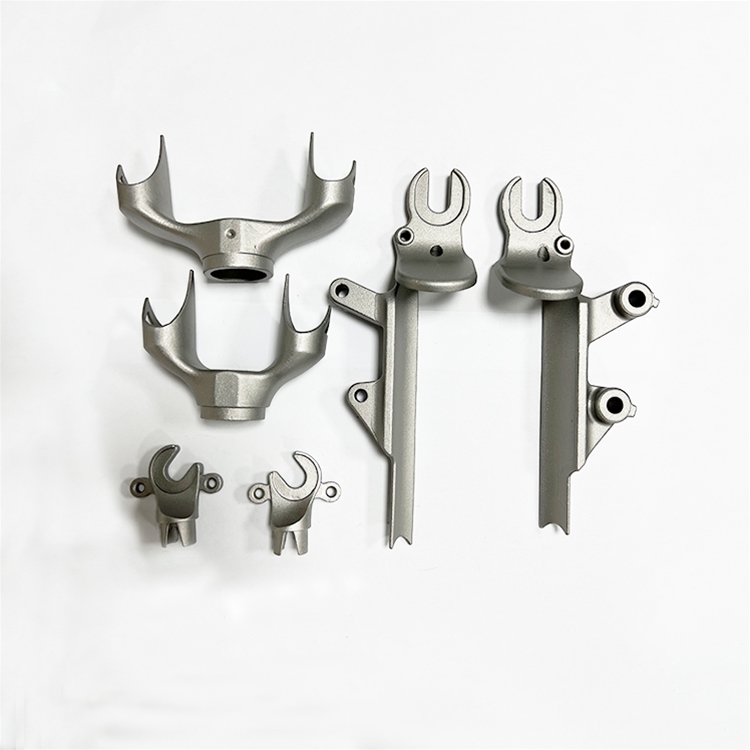
Stainless steelInvestment CastingMachining and application of mechanical parts
Precision casting technology for stainless steel plays a crucial role in modern industry, enabling the production of complex-shaped, dimensionally precise, and high-performance mechanical parts. These parts are widely used in aerospace, medical devices, automotive, food processing, and chemical industries, among others.
Advantages of precision casting
Precision casting of stainless steel typically employs investment casting (also known as lost-wax casting), which offers significant advantages over traditional casting and machining methods.
- High precision and complexity: It can cast parts with complex internal structures and external geometries, reducing or even eliminating subsequent machining.
- Material diversity: It is suitable for a variety of stainless steel grades, such as austenitic stainless steel (304, 316L), martensitic stainless steel and duplex stainless steel, to meet the requirements of corrosion resistance, wear resistance and strength under different working conditions.
- Surface finish: The castings have good surface quality, typically achieving Ra 3.2-6.3μm, which reduces the number of surface treatment steps.
- Cost-effectiveness: For complex parts requiring mass production, precision casting can significantly reduce production costs and processing time.
- High material utilization rate: Compared to machining, precision casting has a higher material utilization rate and reduces waste.
Processing technology flow
The machining process for stainless steel precision casting mechanical parts mainly includes the following key steps:
- Mold making: The wax molds or plastic molds required for precision casting are typically made of aluminum alloy or steel.
- Wax molding: Molten wax is injected into a mold, and after cooling, a wax model is formed that matches the shape of the final part.
- Tree group: Multiple wax models are welded together through a gating system and risers to form a wax model assembly.
- Shell making: The wax mold is repeatedly dipped in refractory slurry and sprinkled with sand, and then dried and hardened to form a multi-layered, sturdy ceramic shell.
- Dewaxing: Place the mold shell in high-temperature steam or hot water to melt and flow out the wax model, leaving a hollow mold shell.
- Roasting: The dewaxed shell is baked in a high-temperature furnace to enhance its strength and remove residual wax.
- pouring: Molten stainless steel is poured into a high-temperature mold under vacuum or a protective atmosphere.
- Shelling and cutting: After cooling and solidification, break the mold shell, remove the casting, and cut off the gating and riser.
- Post-processing: Heat treatment (such as solution treatment, aging treatment), surface treatment (such as sandblasting, polishing, electropolishing), and necessary machining (such as precision turning, milling, drilling, etc.) are performed according to the requirements of the parts to achieve the final dimensional and surface accuracy requirements.
- test: The finished parts undergo comprehensive inspection, including dimensional analysis, chemical composition analysis, mechanical property analysis, and non-destructive testing (such as X-ray and magnetic particle testing).
Application areas
Stainless steel precision-cast mechanical parts are widely used in many industries due to their excellent performance:
- Aerospace: Used in the manufacture of engine turbine blades, structural components, hydraulic system parts, etc., requiring high strength, high temperature resistance and corrosion resistance.
- Medical devices: Used in the production of surgical instruments, implants, medical device components, etc., requiring biocompatibility, high precision, and ease of cleaning and disinfection.
- auto industry: Used in the manufacture of engine parts, turbocharger parts, exhaust system parts, transmission system parts, etc., requiring high strength, wear resistance and corrosion resistance.
- Food processing: Used in the production of valves, pump bodies, pipe fittings, agitators and other components that come into contact with food, requiring high hygiene standards, corrosion resistance and easy cleaning.
- Chemicals and Petroleum: Used in the manufacture of pumps, valves, pipe fittings, reactor components, etc., requiring extremely high corrosion resistance.
- Marine Engineering: Used in ship components, offshore platform equipment, etc., requiring excellent resistance to seawater corrosion.
Development trend
With the continuous advancement of industrial technology, stainless steel precision casting technology is developing towards higher precision, more complex structures, greater environmental friendliness, and greater intelligence. For example, the combination of additive manufacturing (3D printing) and precision casting can further optimize the mold manufacturing process and shorten the development cycle. At the same time, in-depth research on material properties and casting processes will also enable more high-performance, special-purpose stainless steel precision castings.
In summary, stainless steel precision casting technology provides an efficient, economical, and high-quality solution for modern machinery manufacturing. Its application prospects will continue to expand to more fields, driving technological innovation and industrial upgrading in various industries.
Relevant technical information and product examples
Continue to assess whether the materials, workmanship, and actual parts are suitable for your procurement needs.
- Tolerance dataComparison of CNC Machining Tolerance Standards and Selection→
- Tolerance dataInternational tolerance standard for CNC machining: ISO 2768→
- Surface requirementsComparison of Ra, Ry, Rz with polishing treatment→
- Product ExamplesCNC machining of stainless steel precision casting mechanical parts→
Size and processing assessment
Are there any critical dimensions or CNC machining requirements?
Please provide drawings, materials, quantities, and key tolerances. We will conduct an evaluation based on the condition of the blank, clamping method, processing steps, and inspection requirements.
- Confirm machining datum and clamping method
- Evaluate hole positions, threads, and mating surface tolerances.
- Coordinate casting blanks with CNC machining allowances
 WhatsApp: +86 158 9600 2001Scan the QR code or open WhatsApp to chat


