Supports provided drawings and samples; 24-hour response.
Supports provided drawings and samples; 24-hour response.

June 15, 2025
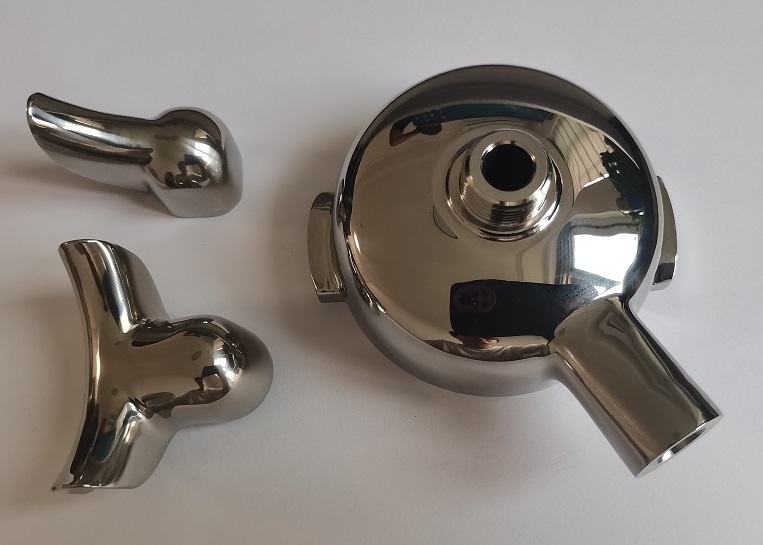
Custom-made stainless steel semi-automatic coffee machine parts – non-standard precision casting parts for espresso machine handles and filter handles. In today's increasingly popular coffee culture, a cup of aromatic espresso is a must.

September 16, 2024
Dear Customers and Employees: On the occasion of the Mid-Autumn Festival, all employees of Xinghua Haijin Stainless Steel Products Factory extend our sincerest holiday wishes to you and your family! The Mid-Autumn Festival is a time for family reunion and the continuation of cherished traditions. On this day of full moon and family gatherings, we wish you and your family happiness, success in your career, and all the best! We sincerely thank our customers for their continued support and trust! Your support is our greatest motivation to continuously pursue excellence and improve our services. We will continue to repay every customer with high-quality stainless steel products and more attentive service, working hand in hand with you to create a better future. At the same time, we also pay tribute to all the hardworking Haijin employees! It is your professionalism and dedication that has enabled our product quality and service standards to continuously improve within the industry. We hope that everyone will spend this special day with their families, fully enjoying the joy and warmth of the festival. …
March 28, 2024
I. Current Status of the Stainless Steel Industry Currently, stainless steel has become an indispensable material in modern industry, with applications spanning construction, petroleum, chemical, food, aviation, and medical fields. With the development of society, economy, and technology, the application of stainless steel is becoming increasingly widespread. In 2019, global stainless steel production exceeded 50 million tons, with China's production exceeding 29 million tons, accounting for nearly 60% of global stainless steel production, making it the world's largest stainless steel producer. However, the stainless steel industry also faces some problems, such as market supply and demand imbalances, imperfect industry standards, low technological levels, and inconsistent product standards. These problems constrain the industry's development, requiring close cooperation between upstream and downstream sectors of the industrial chain, and the adoption of effective strategies and methods to steadily move forward. II. Future Trends of the Stainless Steel Industry In the future, the stainless steel market will continue to expand, exhibiting the following trends: 1. High-end…
March 28, 2024
I. Definition and Types of Tolerance Tolerance refers to the maximum allowable deviation range of a part, and is one of the indicators for measuring the precision requirements of a part. Although stainless steel has excellent corrosion resistance, some deviations can still occur during processing, therefore tolerance control is crucial. Common tolerance types include ordinary tolerance, limiting tolerance, basic tolerance, and grade tolerance. Ordinary tolerance refers to tolerance without specific specifications, limiting tolerance refers to tolerance with some specifications, basic tolerance refers to the tolerance limit for achieving a certain precision grade, and grade tolerance refers to tolerance specified according to grade standards. II. Calculation Formulas for Tolerance The calculation formulas for tolerance vary depending on the type of tolerance. Here are some commonly used tolerance calculation formulas: 1. Ordinary Tolerance: Tolerance value = Upper tolerance - Lower tolerance 2. Limiting Tolerance: Tolerance value = Maximum limit - Minimum limit 3. Basic Tolerance: Basic tolerance = Maximum…
March 27, 2024
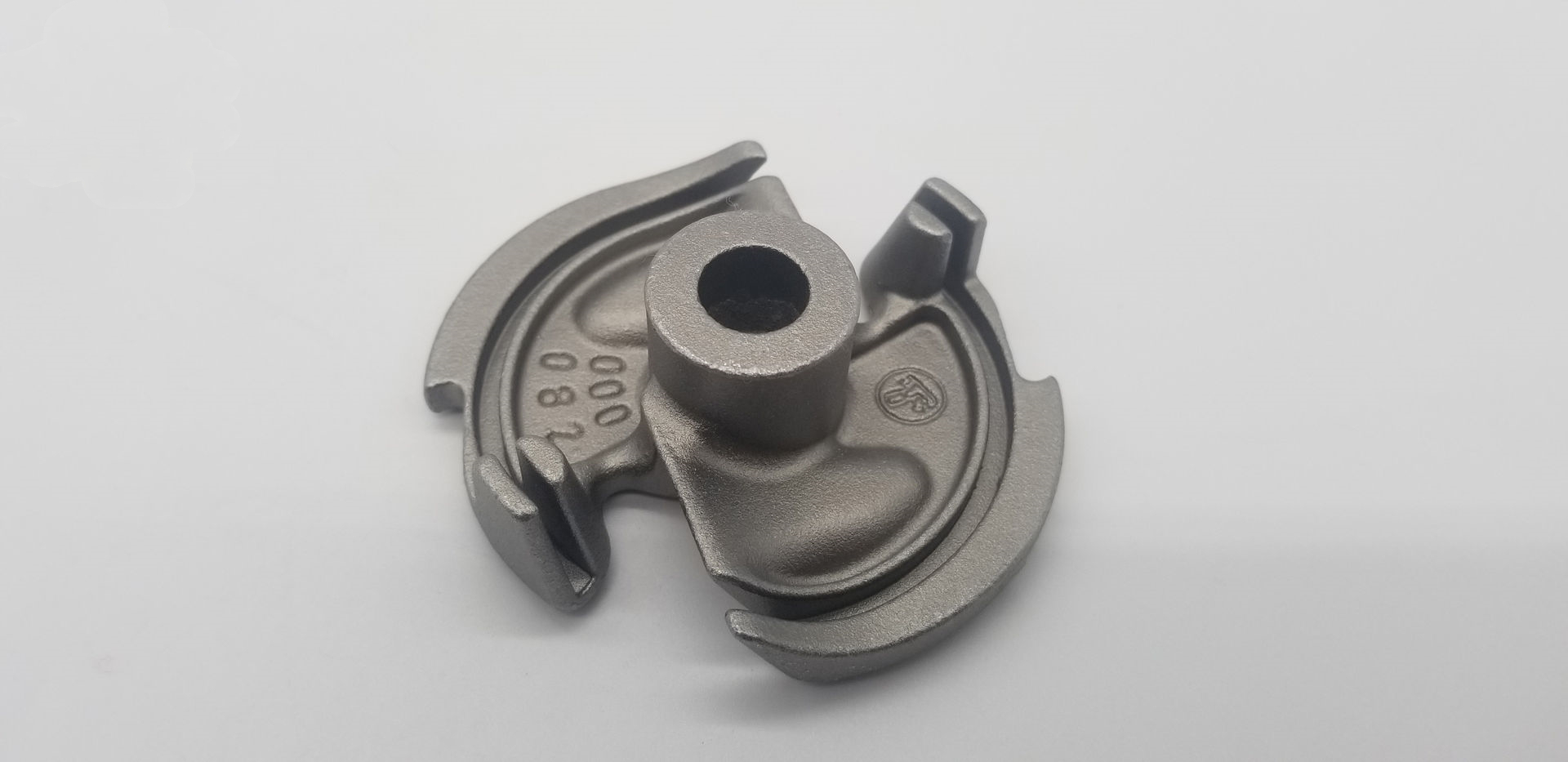
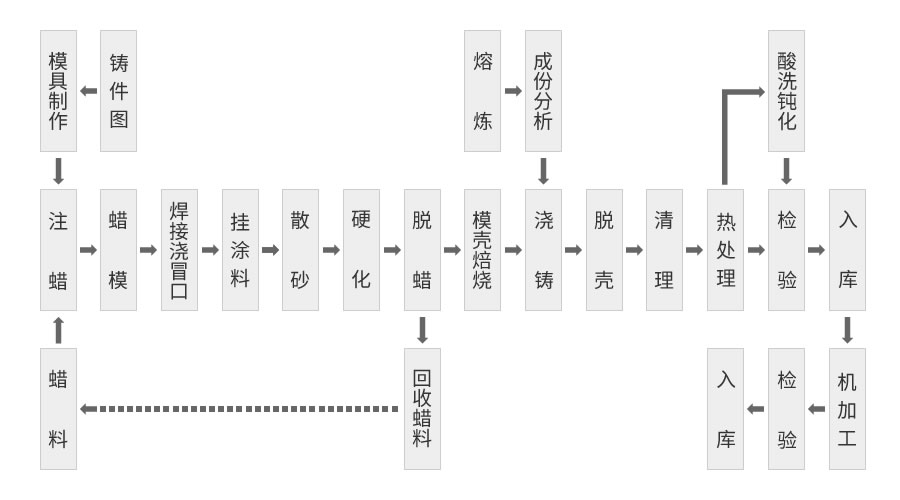
I. What is Precision Casting of Stainless Steel? When producing stainless steel products, some products have unusual shapes that cannot be produced using processes like pipe bending. To produce these irregularly shaped products (hollow or solid inside), a process is used: wax mold → sand mold → liquid material filling and molding. Advantages: A variety of styles can be created based on different wax molds. Disadvantages: The precision of the molded blank is not high, and the surface roughness is relatively large. II. Precision Casting Process Flow 1. Make molds according to different product shapes. Molds are divided into upper and lower concave molds, completed through a combination of processes such as turning, planing, milling, etching, and EDM. The shape and size of the concave mold are consistent with half of the product. Because wax molds are mainly used for industrial wax pressing, aluminum alloy materials with low melting point, low hardness, low requirements, low price, and light weight are selected for the molds. 2. Use aluminum alloy molds to produce a large number of solid industrial wax models. Under normal circumstances, an industrial…
June 8, 2023
Impurities are crucial elements affecting the purity and transparency of the oxide film on stainless steel precision castings. Its thickness, porosity, purity, and sealing quality directly interfere with the mirror finish of the casting. For example, a higher impurity content in the oxide film reduces purity and decreases the transparency of the casting. To ensure a mirror finish on stainless steel precision castings, the impurity content in the oxide film must be reduced. Therefore, the thickness, porosity, purity, and sealing quality of the film must be carefully controlled to minimize impact on processing. Impurities in the oxide film of stainless steel precision castings primarily originate from the casting itself, with some coming from the oxidation bath. Therefore, appropriately reducing the content of alloying elements in the casting can minimize impurity levels. Stainless steel precision casting is a low- or no-cutting casting process, a superior technology in the casting industry with wide applications, suitable not only for casting various types and alloys. ...
June 8, 2023
1. Precision castings are formed by pouring molten metal into a mold and then cooling it. There are many casting processes for precision castings, including metal mold casting, pressure casting, investment casting, lost foam casting, and V-process casting. Precision casting produces relatively precise finished products that require little or no further machining. It can also produce castings with complex shapes and thin thicknesses, easily handling both small and large parts. Currently, precision casting technology is developing rapidly worldwide and has a wide range of applications. 2. Ordinary casting, also known as forging casting, produces relatively rougher parts compared to precision castings. Die casting uses pressure casting. Under high pressure, molten metal is poured into a casting mold at a high speed. The pressure then causes it to solidify. Ordinary casting often uses multiple raw materials…
Enter the material, product name, or processing technology, such as "316L impeller" or "silica sol casting".