










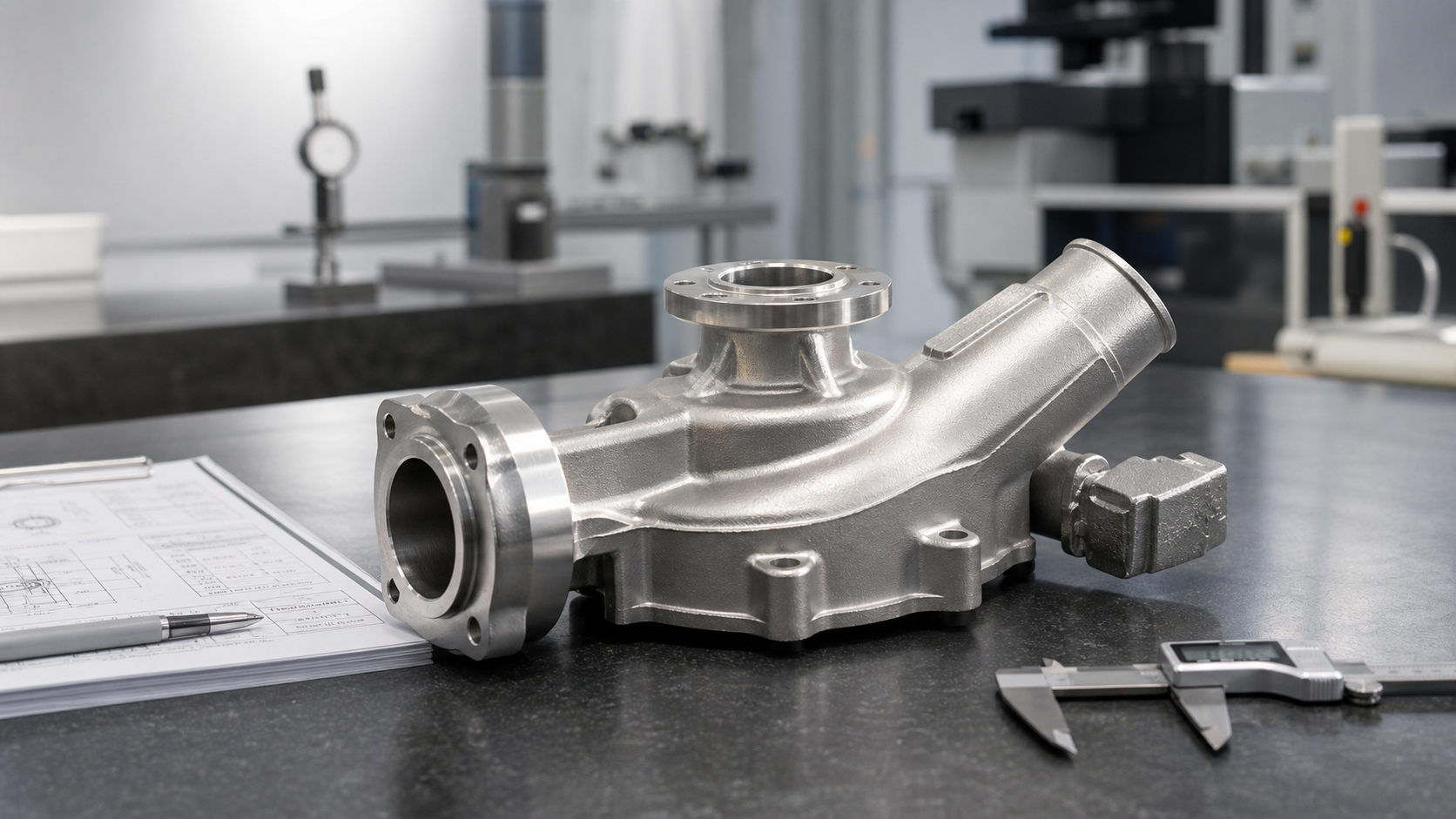
Stainless steel precision castingPump heads, characterized by corrosion resistance, dimensional stability, and strong structural adaptability, are widely used in industrial water supply, circulating cooling, chemical transportation, food processing equipment, marine applications, and environmental water treatment. For components like pump heads that bear pressure, handle flow, and require high assembly precision, [further details are needed].Precision castingIt can not only form complex flow channels, flanges, reinforcing ribs and mounting holes in one step, but also reduce the subsequent welding and machining allowances and improve product consistency.
Typical applications of stainless steel precision cast water pump heads
In a water pump system, the pump head undertakes key functions such as media guidance, pressure conversion, and connection sealing. Precision casting using 304, 316, or 316L stainless steel materials can meet the requirements for use with clean water, mildly corrosive liquids, seawater environments, and some chemical media.
Its applications are mainly concentrated in the following scenarios:
- Industrial circulating water pumps are used in applications such as cooling towers, heat exchange systems, and production line circulating water supply. The pump head is required to have stable corrosion resistance and pressure resistance.
- Food and pharmaceutical equipment: Stainless steel is easy to clean and is suitable for fluid transport equipment where hygiene, surface quality and material safety are required.
- Chemical and environmental protection equipment: When dealing with media containing salt, acid, alkali or sewage, precision cast pump heads can improve corrosion resistance and lifespan through material selection and heat treatment.
- Marine and offshore engineering applications: The marine environment places higher demands on the corrosion resistance and structural strength of castings, and stainless steel pump heads can reduce the frequency of maintenance.
- Non-standard equipment matching: For special flow rates, installation space or interface types, precision casting facilitates small-batch, multi-specification customization.
Manufacturing advantages brought by precision casting
The internal flow channels of a water pump head are complex. If traditional processing methods are used, there are often problems such as high processing difficulty, large material waste, welding deformation, and sealing risks. Precision casting, through wax modeling, shell making, firing, pouring, and post-processing, can form complex structures in one step, reducing the need for component assembly.
For mass production, the value of precision casting is mainly reflected in three aspects: first, it improves dimensional consistency, which facilitates subsequent assembly; second, it optimizes the flow channel structure and reduces fluid resistance; and third, it reduces overall manufacturing costs, especially suitable for pump and valve parts with complex structures but stable batch production.
Common casting defects and their causes
The quality risks of pump head castings mainly include porosity, shrinkage cavities, inclusions, cold shuts, cracks, deformation, and surface roughness. Porosity is mostly related to wax pattern venting, shell permeability, gas content in the molten metal, and pouring speed; shrinkage cavities usually occur in thick parts or hot spots, due to improper design of the feeding channels; inclusions are closely related to deoxidation, filtration, and the cleanliness of the gating system; cold shuts are mostly caused by low pouring temperature, poor filling of the mold with molten metal, or improper flow channel design.
For water pump heads, the internal flow channels, flange roots, intersections of reinforcing ribs, and areas where thickness transitions are most likely to concentrate defects, and are also key areas for process control.
How to eliminate or reduce casting defects
To ensure stable production of high-quality stainless steel precision cast pump heads, we cannot rely solely on end-of-line inspections. Instead, we must implement preventative measures throughout the entire process, from design and mold making to shell production, smelting, casting, heat treatment, and testing.
First, casting process reviews should be conducted during the product design phase to ensure proper setting of fillets, wall thickness transitions, and machining allowances, avoiding isolated hot spots. For complex pump heads, solidification simulation analysis can be used to analyze risers, ingates, and feeding schemes to identify shrinkage cavities and porosity risks in advance.
Secondly, the quality of the wax model and the mold shell must be consistent. The size, surface integrity, assembly angle, and venting position of the wax model will all affect the final casting. The mold shell needs to ensure strength, permeability, and refractoriness; insufficient drying or uneven shell layer may lead to sand inclusions, sparking, or surface defects.
Third, the smelting and casting processes must be strictly controlled. Stainless steel smelting should focus on composition, temperature, deoxidation, slag removal, and the cleanliness of the molten metal. Excessively high casting temperatures can lead to coarse grains and sand adhesion, while excessively low temperatures may cause cold shuts and incomplete casting. Therefore, a stable casting window needs to be determined based on the pump head wall thickness, structural complexity, and material grade.
Fourth, post-processing and testing of critical components should be strengthened. Heat treatment can improve microstructure and stress state, while shot blasting, pickling, and passivation can improve surface quality and corrosion resistance. For pressure pump heads, dimensional inspection, penetrant testing, airtightness or water pressure testing should be combined, and spectral, hardness, and metallographic analysis should be performed when necessary to ensure that the castings meet the usage requirements.
Conclusion
Precision-cast stainless steel pump heads are not only structural components of pump equipment, but also directly affect the sealing, efficiency, and service life of the entire machine. To eliminate defects, the key lies in moving quality control upstream: identifying risks from the structural design stage, resolving feeding and venting issues in the process design, stabilizing melting and casting parameters during production, and verifying the final quality through testing. Only by establishing a complete process control system can we consistently deliver corrosion-resistant, dimensionally accurate, and reliable pump head castings.